Three different tools for tasks, one chat for follow-up questions, plus a shared spreadsheet for deadlines – and still nobody knows who is currently working on what. Tasks get lost, deadlines slip, and responsibilities remain unclear. But which task management software actually solves this chaos while also meeting Germany’s strict data protection requirements? This comparison takes a close look at five tools: Stackfield, Asana, MeisterTask, awork, and Factro – evaluated based on functionality, security, and target audience fit.
Use a secure all-in-one tool: Why use three separate tools for chat, tasks, and video conferencing and lose track of everything? With Stackfield, you combine your entire project work in one place. Thanks to true end-to-end encryption and hosting in Germany, your data remains guaranteed private.
Put an end to tool chaos now
The essentials at a glance
- Tasks, communication, and files: Organizing these across separate tools means paying twice – through license costs and time lost switching between systems.
- Data protection is not optional: Server location, subprocessors, and true end-to-end encryption determine GDPR compliance.
- All-in-one vs. specialized solutions: Combining tasks, communication, and files in one tool reduces licensing costs.
- Stackfield as the only provider: Complete EU data hosting including subprocessors, combined with true end-to-end encryption.
- Context matters: Team size, compliance requirements, and feature scope are the key decision-making criteria.
How does a task management tool differ from other solutions?
As the name suggests, task management tools help you and your team manage tasks efficiently and in a structured way. Task management software typically covers four core processes: planning, coordinating, executing, and monitoring tasks. Common features include centralized task management, dashboards, lists, and Kanban boards – everything teams need to answer the question: "Who is doing what by when?" at any time. But what practical difference does such a tool actually make in day-to-day work?
It is important to distinguish task management from project management: a task management tool focuses on the operational task level. Project management software, on the other hand, covers the entire project lifecycle, from budget planning and milestones to Gantt charts. In practice, the boundaries often blur because many providers combine both areas within a single platform.
What are the advantages of a task management tool?
A task got lost or a deadline was missed – sounds familiar? With a task management tool, situations like these become far less common. The benefits are clear:
- Overview of all tasks: Using dashboards, lists, or calendar views, your team always has visibility into open tasks and their current status. This makes it easier to assess whether tasks or projects can realistically be completed on time.
- Clear responsibilities: Every team member knows exactly which tasks they are responsible for and by when they need to be completed.
- Centralized information: All information required to complete a task is stored in one place, directly within the task itself. Teams no longer need to switch constantly between different tools and folders.
- More effective collaboration: When everyone knows what they need to do and where to find the necessary information, significant time is saved. Automations can additionally handle routine work such as status updates or deadline reminders, reducing the need for manual coordination within the team.
A task management tool becomes especially powerful when it combines team collaboration and task management within one platform. Automations then take over repetitive processes such as status changes or reminder notifications, creating another major efficiency gain by reducing manual coordination efforts.
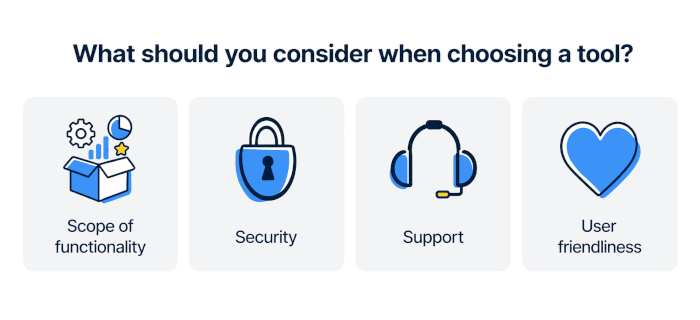
What should you consider when choosing a tool?
Not every task management solution fits every organization. Before comparing tools, it makes sense to structure your own requirements based on clear criteria. Priorities vary depending on team size, industry, and compliance requirements – a small Kanban-focused startup has very different needs from a public-sector organization with strict data protection obligations.
- Feature set: A good tool should at minimum provide task management, multiple project views (Kanban boards, Gantt charts, list views), and time tracking. Another critical consideration is the choice between an all-in-one platform and specialized standalone tools. Teams that organize communication, file management, and tasks in separate applications often end up paying twice, through additional license costs and through the productivity loss caused by constantly switching between tools.
- Security: Data protection is not an optional recommendation for companies in Germany, but a legal obligation. Three checkpoints belong on every checklist: server location in Germany / the EU, the location and data processing of subprocessors, and the encryption standard used. Certifications such as ISO 27001 and BSI C5 provide transparent, independently verified proof that goes beyond pure marketing claims.
- Support: The quality of support is often underestimated when selecting a tool, yet in critical situations it determines whether hours are lost. Three dimensions matter: language (German vs. English), channel (live chat, phone, ticket system, or chatbot), and response time. Anyone who can only reach an English-speaking bot during a critical issue loses valuable time.
- Usability: If the software itself becomes difficult to use, the entire project schedule can slow down. Intuitive navigation, clear dashboards, and a low learning curve are therefore essential characteristics. Training and onboarding resources for teams are equally important to ensure smooth adoption.
Task management tools compared: We tested these 5
For this tool comparison, we selected five task management solutions that are widely used in the DACH region and target different audiences: Stackfield, Asana, MeisterTask, awork, and Factro. All five tools were evaluated using the same criteria, ranging from feature scope and data protection (GDPR) to support quality and target group fit. The following overview shows at a glance which core features and data protection characteristics each of the five tools offers.
| Criterion: |
Stackfield |
Asana |
MeisterTask |
awork |
Factro |
| Project views (Gantt, Kanban, List) |
✔ |
✔ |
no Gantt |
✔ |
Gantt from Business plan |
| Time tracking |
✔ |
✔ |
✔ |
✔ |
✔ (from Professional plan) |
| Video conferencing |
✔ |
✖ |
✖ |
✖ |
✖ |
| True end-to-end encryption |
✔ |
✖ |
✖ |
✖ |
✖ |
| Server location |
Germany |
USA (EU from Enterprise) |
Germany |
Germany |
Germany |
| Subprocessors in DE / EU |
✔ |
✖ |
✖ |
✖ |
✖ |
| German-language support |
Live chat + phone |
✖ |
✔ |
Live chat + phone |
Phone + email |
Stackfield
Stackfield combines task management, team chat, video conferencing, whiteboards, and file management in one platform, eliminating the need for additional tools. The interface is clearly structured and systematically designed, allowing new users to quickly find their way after onboarding. Stackfield also focuses on accessibility, including compatibility with screen readers.
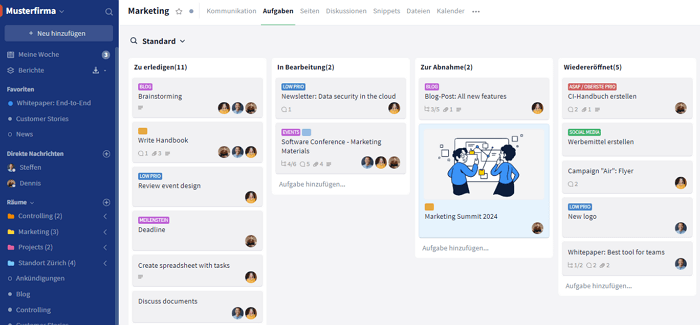
Customer support is available in German via live chat and phone. This means you communicate with real people instead of chatbots. In addition, a comprehensive Learning Center is available to support users working with the task management tool.
As a German provider, Stackfield is ISO 27001 certified and BSI C5 attested. Both the server location and subprocessors are located exclusively in Germany / the EU. In addition, Stackfield provides true end-to-end encryption, meaning even Stackfield itself has no access to your content.
Strengths at a glance:
- True end-to-end encryption
- All-in-one platform: tasks, chat, video conferencing, whiteboards, and file management
- ISO 27001 certified and BSI C5 attested
- Server location and subprocessors exclusively in Germany / the EU
- Live chat and phone support
Limitations:
- Minimum of five licenses required, making it unsuitable for very small teams with fewer than five users
This makes Stackfield particularly suitable for teams with high data protection requirements, including the public sector, law firms, banks, healthcare organizations, and SMEs with compliance obligations.
Is Stackfield the right fit for your team?
Find out for yourself – test all features free of charge for 14 days. No credit card required, with full functionality available from day one.
Start your free trial now
Asana
Asana is a US-based project management software that offers a workflow builder with automations, seven dashboard areas (Board, Timeline, Calendar, Progress, Forms, Files, Discussions), and integrations including Slack, Salesforce, and MS Teams.
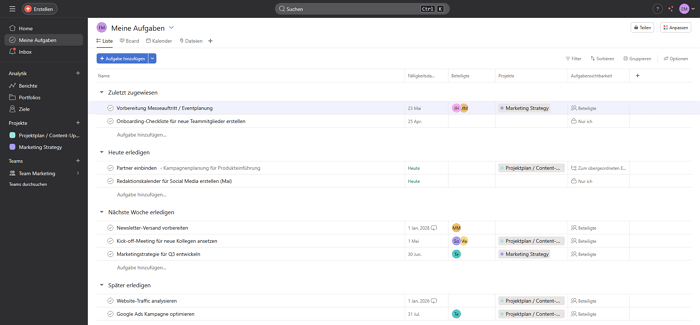
For support, users have access to a help center with video tutorials as well as an active community. Support tickets can be created through a bot, but German-language live support is not available.
Strengths:
- Views: Kanban board, timeline, calendar, and list
- Workflow builder with automations for recurring processes
- Integrations with common third-party tools
Limitations:
- US provider with data primarily hosted on US servers. EU hosting available only from the Enterprise plan onward
- No German-language live support (chatbot and ticket system only)
- No true end-to-end encryption
- Subject to the CLOUD Act
Asana is suitable for teams without a primary focus on data protection that require many parallel projects and integrations. Teams looking for a privacy-focused alternative can find a direct comparison on the page "Stackfield as an Alternative to Asana".
MeisterTask
MeisterTask is a European provider headquartered in Munich that focuses on Kanban-based task management. The Kanban board serves as the central view, complemented by automation features for recurring tasks such as status changes or assignments. Getting started is quick, as the tool intentionally focuses on the core functions of task management.
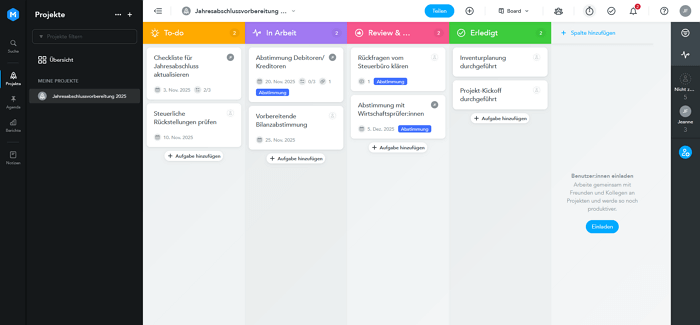
Users have access to a help center, video tutorials, and a community for support. Individual support depends on the selected subscription plan.
Strengths:
- Intuitive Kanban board
- Automations for recurring workflows
- German-language support and server location in Germany
Limitations:
- No native Gantt chartt
- No whiteboard, no video conferencing, and no group chat
- Google as a subprocesser, meaning data leaves the EU
- No portfolio management for overseeing multiple projects
MeisterTask is suitable for smaller teams looking for an easy introduction to task management without requiring an extended feature set.
awork
Awork is a German task management tool with a focus on task management, time tracking, and resource planning. Time tracking is integrated directly into tasks and complemented by capacity planning for distributing workloads across teams. German-language support is available via live chat and phone.
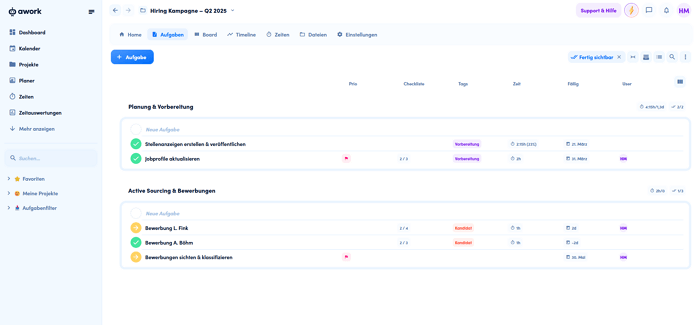
The tool positions itself as GDPR-compliant with servers located in Germany and is specifically aimed at agencies and service providers that want to combine project management, time tracking, and team planning within one platform.
Strengths:
- Time tracking integrated directly into tasks
- Resource and capacity planning for team workloads
- German-language support via live chat and phone
- Server location in Germany
Limitations:
- Microsoft Ireland as a subprocesser, meaning data leaves the EU
- No integrated whiteboard or video conferencing
- No portfolio management and no group chat
Awork is suitable for agencies and service providers looking to combine projects, time tracking, and team planning.
Factro
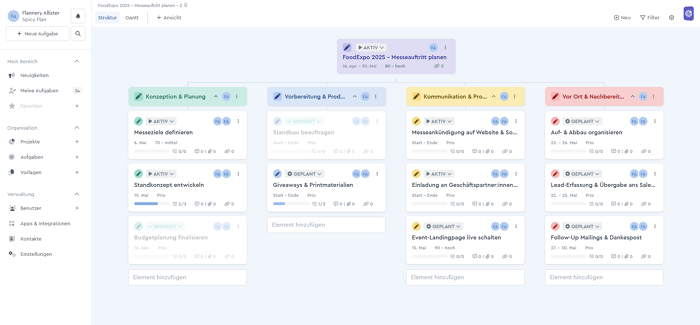
Factro is a German task management tool with a focus on task and project structure planning. A project structure plan is available as a native view, complemented by Kanban boards and Gantt charts, although the latter is only available starting with the Business plan. A traffic light color system displays the deadline status of each task: green means "on track," yellow signals "approaching deadlines," and red marks "overdue." Support is available in German via phone and email.
Strengths:
- Native project structure tree for task planning
- Traffic light color system for deadline visibility
- German-language support via phone and email
Limitations:
- Digital Realty as a subprocesser, meaning no complete EU-only data hosting
- No whiteboard, no video conferencing, and no group chat
- No portfolio management for coordinating multiple projects
- Time tracking only included in the Professional Cloud plan
Factro is suitable for mid-sized companies looking for structured project management with clear task hierarchies while handling communication through external tools.
Security as a decisive factor
Many providers advertise themselves as "GDPR-compliant," but this label alone says very little. What really matters is where data is actually processed, not only on the provider’s own servers but also by every subprocesser involved in the processing chain. Even European providers may process data through US-based subservice providers, making them subject to access requests under the CLOUD Act. Anyone who takes data protection seriously must therefore evaluate both server location and subprocessors together.
The differences become clear in direct comparison: Asana primarily hosts data in the US, the CLOUD Act applies, and true end-to-end encryption is missing. MeisterTask uses Google as a subprocesser, meaning data leaves the EU. Awork relies on Microsoft Ireland, which also results in data transfers outside the EU. Factro uses Digital Realty as a subprocesser, which does not guarantee fully EU-based data hosting.
Stackfield, on the other hand, uses Germany as its server location and seeks to ensure that data never leaves the EU, including through subprocessors. In addition, unlike other providers, data in Stackfield is protected with true end-to-end encryption, meaning not even Stackfield itself can access the content. ISO certifications 27001, 27017, and 27018 as well as BSI C5 confirm the platform’s high security standards.
Conclusion: The right tool depends on your requirements
Choosing the right task management software is not about selecting the tool with the longest feature list, but the one that best fits your team. Data protection requirements, team size, desired feature set, and budget all need to align. A small team primarily looking for a Kanban board will come to different conclusions than a public authority with strict compliance requirements. Each of the five tools compared here has its place – what matters is which requirements are most important for your organization.
For teams that need strong data protection, complete EU-only data hosting including subprocessors, and a broad feature set, Stackfield is the only solution in this comparison that covers all three dimensions. Tasks, chat, video conferencing, and file management are combined within one platform, protected by true end-to-end encryption that prevents even the provider itself from accessing your content.
Ready for the next step? Test Stackfield free for 14 days with full functionality – risk-free and without a credit card. Personal support in German helps guide you through the onboarding process.
Start your 14-day trial now
FAQ
Which tool best fulfills GDPR requirements?
What matters is not only the provider’s own server location, but also the subprocessors involved in the data processing chain. In this comparison, Stackfield is the only provider offering complete EU-only data hosting including subprocessors together with true end-to-end encryption. All other tools transfer data through subservice providers outside the EU. You can test Stackfield free for 14 days.
Which task management tools are suitable for the public sector?
Public authorities face particularly strict data protection requirements. Server location, subprocessors, and encryption standards must be fully transparent and verifiable. As a project management tool for public administration, Stackfield is the only provider in this comparison that fulfills all three criteria, including BSI C5 certification, which was specifically developed for cloud services used by the public sector.
Are there task management tools with a free version?
Asana offers a free basic version for up to 15 users, while MeisterTask and factro also provide permanently free plans. However, these plans come with limited functionality, which can restrict efficient collaboration for teams. Instead, Stackfield offers a 14-day trial with full functionality included.