The essentials at a glance
- Tool consolidation as a trend: Teams are reducing their stack from five to seven apps down to two or three platforms. All-in-one solutions outperform specialized tools because fewer tools mean less friction.
- Data protection gap in rankings: No current top rankings systematically evaluate collaboration tools based on GDPR compliance, encryption type, and certifications. Yet only about one third of companies use highly secure solutions.
- Native integration reduces cognitive load: Combining chat, tasks, and documents in one platform eliminates context switching and information loss more effectively than patching together third-party tools.
- Stackfield as the all-in-one answer: Stackfield combines project management, communication, and file management in a German platform with true end-to-end encryption, solving the problem of information loss caused by tool switching.
Whether within your organization or collaborating with external partners, in the office or remotely, collaboration tools keep teams connected. Regardless of time or location, team members can work together on documents, communicate efficiently, and coordinate projects, enabling smooth workflows and maximum productivity.
But which collaboration tools truly take teams to the next level? This comparison goes beyond simple feature lists. It evaluates the best collaboration tools across three dimensions that are often missing from existing rankings: data protection, total cost at scale, and native integration. Alongside Microsoft Teams and Slack, it also includes Stackfield, a German all-in-one platform with true end-to-end encryption.
What benefits do teams gain from using collaboration tools?
Business and project success largely depends on excellent teamwork. This becomes especially challenging when teams are large or when many members work remotely or from home. Collaboration tools can support teamwork on multiple levels:
- More efficient workflows: Collaboration software shortens communication paths and enables real-time co-editing of documents.
- Availability anytime, anywhere: All important information is easily accessible to all team members at any time and can be retrieved from different devices.
- Clear task management: Transparent project plans make it easy to assign, move, and complete tasks on time.
- A central place for all information: Especially with an all-in-one platform, all relevant information can be bundled in one place, from messages and files to tasks and calendars.
The difference compared to pure project management software: project management tools focus on planning, execution, and control of projects. Communication platforms, on the other hand, primarily cover messaging. Collaboration tools ideally combine both areas, creating a seamless working environment – from replacing email to cross-team project collaboration.
According to a Gartner study, 61% of organizations are actively reducing their standalone apps and instead relying on consolidated solutions. As a result, all-in-one platforms that natively combine communication, tasks, and file management are becoming significantly more important.
"The real productivity killer is not the work itself, but constantly switching between tools. Anyone who opens five apps in the morning before starting their first task loses time and focus. Stackfield brings everything together in one interface, not because it sounds technically impressive, but because it makes everyday work noticeably easier."
Cristian Mudure, Stackfield CEO
The six best collaboration tools compared
Working from different locations while staying connected is what collaboration tools promise. But how well do these digital tools actually deliver on that promise? And what are their strengths and weaknesses?
|
Stackfield |
Microsoft Teams |
Slack |
Asana |
ClickUp |
awork |
| Main category |
All-in-One |
Communication hub |
Messaging |
Task management |
Project management |
Task management |
| Price from (per user / month) |
from €9.00 |
from €3.50 |
from €6.75 |
from $13.49 |
from $7.00 |
from €5.00 |
| Server location |
Germany |
USA / optional EU |
USA |
USA (EU from Enterprise) |
USA |
Germany |
| True End-to-end encryption |
Yes |
No (only for individual calls optionally) |
No |
No |
No |
No |
Stackfield: all-in-one project management with true end-to-end encryption
Stackfield is a German all-in-one project management solution that natively combines chat, video conferencing, whiteboards, file management, and a collaborative office suite within a single platform. Instead of stitching together multiple standalone tools, all features operate on a shared data base, eliminating context switching and duplicate data storage. The interface can be reduced to only the modules a team actually needs, keeping the application lean. A key differentiator: Stackfield is the only tool in this comparison that offers true end-to-end encryption, meaning not even Stackfield itself can access your data.
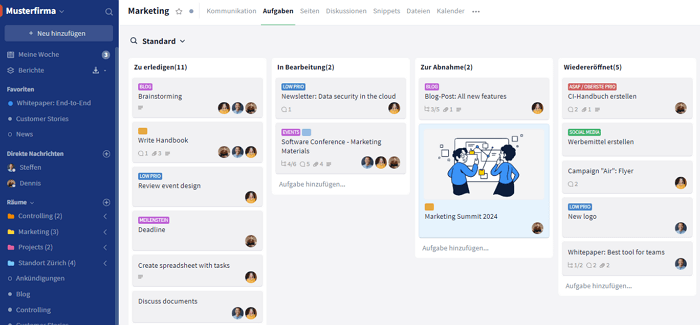
Core features at a glance
- Task management with Kanban boards, Gantt charts, and list view
- Group chat and direct messages
- Audio and video conferencing with screen sharing
- Whiteboards for visual collaboration
- File management with folder structure
- KCollaborative office suite (based on Collabora) for documents, spreadsheets, and presentations
- Time tracking, workflows, and project portfolios
Strengths:
- True end-to-end encryption – not even Stackfield can access your data
- German data hosting, ISO 27001, BSI C5, ISO 27017, and ISO 27018
- Personal phone support in German, no chatbots
- All-in-one replaces multiple standalone tools and reduces total costs
- OMR rating: 4.8 / 5
Limitations:
- No permanent free plan, but a 14-day trial
- Minimum of five licenses required, therefore not suitable for individuals
Target group:
Teams of five or more looking to replace tool chaos with a structured all-in-one platform. Particularly popular in data-sensitive sectors such as the public sector, healthcare, and finance. Organizations such as BRK Rettungsdienst and the city of Erlangen already use Stackfield.
Data protection:
As a German provider with German data hosting, true end-to-end encryption, ISO 27001, BSI C5, and no CLOUD Act exposure, Stackfield offers the highest level of protection in this comparison.
Pricing:
Starter from €9 per user / month (annual plan, five licenses), Business from €14 per user / month, Enterprise from €28 per user / month. The 14-day trial starts without a credit card.
Microsoft Teams: communication hub in the Microsoft ecosystem
With over 300 million active users, Microsoft Teams is an enterprise platform for team communication. One of its key advantages is the Microsoft 365 ecosystem. Companies already using Word, Excel, PowerPoint, SharePoint, and OneDrive will find in Teams a central communication hub that connects these applications.
What Teams does not offer: full-featured project management, true end-to-end encryption, and data hosting independent of the CLOUD Act. This is why many teams use Stackfield alongside it, for structured project management with real security guarantees, while continuing to use the familiar Teams interface for daily communication. Through the Stackfield integration, tasks and whiteboards can be accessed directly within Teams channels. Those considering a full switch can explore options in comparisons of Microsoft Teams alternatives.
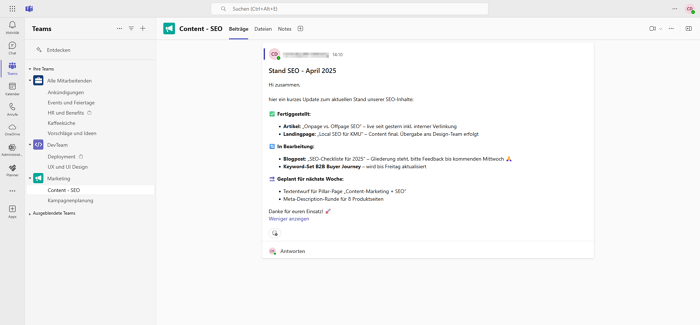
Core features at a glance
- Chat and channels for structured communication
- Video conferencing with large participant capacity
- Integration with Word, Excel, PowerPoint, SharePoint, and OneDrive
- Planner for task management
- Whiteboard app and Copilot AI
Strengths:
- Deep integration into the Microsoft ecosystem
- Already included in many Microsoft 365 licenses
- Familiar interface for existing Microsoft users
Limitations:
- Project management only via Planner or Project as an add-on
- No true end-to-end encryption for chat, files, and tasks
- US provider with CLOUD Act exposure
- Complex and sometimes cluttered user interface
Target group:
Organizations already working within the Microsoft ecosystem. For public authorities or organizations with strict GDPR requirements, Microsoft should be evaluated critically due to CLOUD Act implications.
Data protection:
US provider, EU data hosting optional, no true end-to-end encryption for all content, CLOUD Act exposure.
Pricing:
Teams is included in many Microsoft 365 plans but can also be licensed separately, starting from Essentials at around €3.50 per user / month, Business Basic at €5.20 per user / month, and Business Standard at €10.80 per user / month. The "free" plan is only available as part of an existing Microsoft 365 subscription.
Slack: channel-based communication for agile teams
Slack has shaped channel-based team communication and established itself as a widely used messaging tool. Its focus is on fast communication. Teams that need task and project management must integrate additional tools. For teams with high data protection requirements, it is worth considering secure Slack alternatives that natively combine communication and project management.
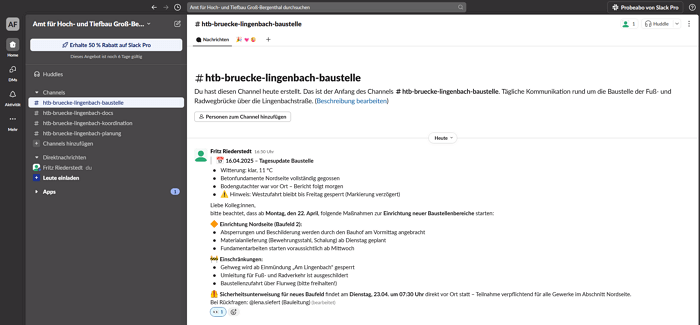
Core features at a glance
- Channels and direct messages for structured communication
- Huddles for spontaneous audio and video conversations
- Slack AI for summaries and intelligent search
- Workflow Builder for automations
- Canvas for collaborative documents
- App ecosystem
Strengths:
- Integration ecosystem with over 2,600 integrations
- Simple interface for fast team communication
- AI features with Slack AI
Limitations:
- No native task or project management
- Free plan limited to 90 days of message history
- Costs scale quickly (Business+ at 100 users approx. $15,000 per year)
- US provider (Salesforce subsidiary), data hosted on US servers, no true end-to-end encryption, CLOUD Act exposure
Target group:
Agile teams looking for a messaging-first solution and handling project management with separate tools.
Data protection:
US provider, no true end-to-end encryption, CLOUD Act exposure, data stored on US servers.
Pricing:
Free plan available (90-day message history). Pro from €6.75 per user / month, Business+ from €15 per user / month billed annually, Enterprise+ pricing on request.
Asana: task and workflow management for structured teams
Asana is a platform for structured task management that offers multiple views, including lists, boards, timelines, and portfolios. It is designed for teams that require clear workflows and responsibilities and handle communication through separate tools. Teams looking for an Asana alternative with integrated communication, time tracking, and German data hosting will find Stackfield to be a suitable option.
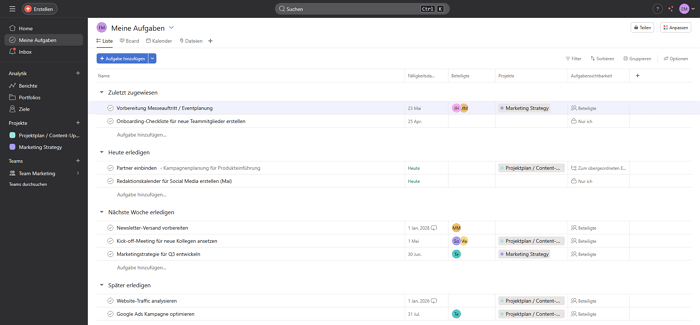
Core features at a glance
- Tasks with subtasks and dependencies
- Kanban, list, timeline, and calendar views
- Portfolio management for cross-project control
- Workflow automations and forms
- Reporting and dashboards
Strengths:
- Portfolio management for overseeing multiple parallel projects
- Timeline view for planning project phases
- Free plan available for small teams
Limitations:
- No integrated communication (no chat, no video)
- No native time tracking
- EU data hosting only available in the Enterprise plan
- No true end-to-end encryption
- Prices increase quickly as teams scale
Target group::
Teams that prioritize structured task management and use separate tools for communication.
Data protection:
US provider (headquartered in San Francisco), CLOUD Act exposure, EU data hosting only available in the Enterprise plan, no true end-to-end encryption. A data processing agreement can be concluded.
Pricing:
Personal free (up to two users), Starter from €11 per user / month, Advanced from €24.99 per user / month, Enterprise pricing on request.
ClickUp: feature-rich platform for advanced workflows
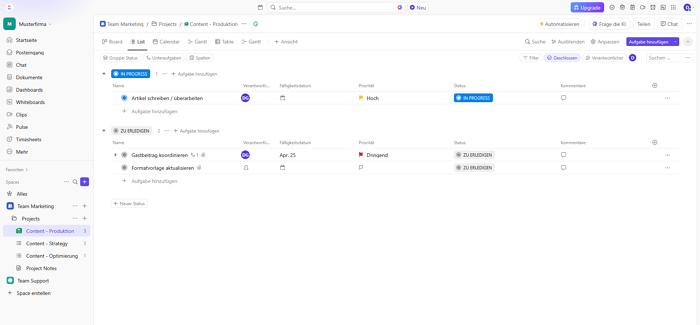
ClickUp combines tasks, docs, chat, whiteboards, and AI features in one platform. The approach is similar to Stackfield but differs in one key aspect: the default server location is in the United States. Teams looking for a ClickUp alternative with German servers and true end-to-end encryption will find Stackfield to be a suitable option.
Core features at a glance
- Tasks with more than 15 different views
- Docs for collaborative writing
- Chat and whiteboards
- Time tracking and dashboards
- ClickUp Brain (AI) for summaries and task generation
- Automations and custom workflows
Strengths:
- Wide range of features in one tool with multiple views
- Free plan available
- High level of customization
Limitations:
- Steep learning curve due to the extensive feature set
- Performance issues in large workspaces according to user reports
- No true end-to-end encryption
- No EU data hosting by default
Target group:
Tech-savvy teams seeking maximum flexibility and willing to invest time in onboarding.
Data protection:
US provider (headquartered in the United States), CLOUD Act exposure, servers primarily located in the US. EU data residency is available as an option for enterprise customers. A data processing agreement is available.
Pricing:
A free plan is available. The Unlimited plan starts at $7 per user / month, while the Business plan starts at $12 per user / month. Pricing for the Enterprise plan is available on request.
awork: German collaboration tool for agencies and teams
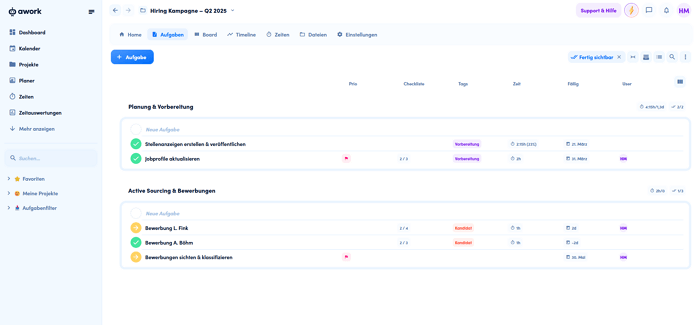
Awork is a German platform for task and resource planning based in Hamburg. Its focus is on agency workflows, time tracking, and a simple user interface. Teams that require integrated communication, true end-to-end encryption, and BSI C5 certification should consider GDPR-compliant collaboration tools such as Stackfield.
Core features at a glance
- Tasks with Kanban, list, and timeline views
- Time tracking with reporting
- Resource planning and capacity overview
- Project planning and calendar
- Automations for recurring workflows
Strengths:
- German server location, GDPR-compliant processing
- Time tracking and resource planning features
- German-language support
Limitations:
- No integrated communication (no chat, no video)
- No true end-to-end encryption
- Microsoft Azure as infrastructure provider – CLOUD Act exposure due to US provider despite German server location
- Limited file management (no folder structure)
Target group:
Agencies and creative teams that prioritize time tracking and resource planning. Less suitable for public sector organizations or highly regulated industries with strict compliance requirements.
Data protection:
German provider with German server location, but Microsoft Azure (US provider) as a subcontractor, resulting in no full data sovereignty. No true end-to-end encryption.
Pricing:
Basic from €5 per user / month, Standard from €11, Professional from €19, Enterprise on request, all billed annually.
Which of the most popular collaboration tools is the best?
There is no universally "best" tool. As is often the case, choosing the right solution depends on several factors: the complexity of your projects, industry requirements and data protection needs, team size, and how familiar your team is with collaborative work. The decision should be made carefully, as approval processes and onboarding can be time-consuming. All-in-one solutions offer a clear advantage here by covering many functions within a single tool.
In data-sensitive industries such as public authorities, banks, law firms, insurance companies, or research institutions, GDPR compliance and data protection are top priorities. Solutions hosted in the United States must be evaluated critically in these contexts. You are on the safe side with a provider like Stackfield, which limits data storage and processing to the EU and ideally includes true end-to-end encryption. Once certifications such as BSI C5 and ISO 27001 are required, the selection becomes significantly narrower. The next section helps you systematically choose the right solution for your team.
Best collaboration tools: making the right choice for your team
The comparison table already shows that there are significant differences between the six tools, especially in terms of data protection and integration depth. Two dimensions deserve closer attention before making a decision: actual GDPR compliance and whether an all-in-one approach provides more value than a stack of specialized tools.
Data protection check: GDPR, CLOUD Act, and encryption in comparison
An EU server location alone does not automatically make a collaboration tool GDPR-compliant. The CLOUD Act obliges US companies to provide data to American authorities upon request, regardless of where the servers are physically located. The EU-US Data Privacy Framework creates a legal basis but remains politically fragile. At the same time, regulations such as NIS2 and DORA are increasing compliance pressure on companies in the EU. The reality: according to a techconsult study (October 2024), 83% of companies experienced data protection-related security incidents within the last 24 months.
| Criterion |
Stackfield |
Microsoft Teams |
Slack |
Asana |
ClickUp |
awork |
| Server location in Germany |
Yes |
No (EU optional) |
No |
No (EU from Enterprise) |
No |
Yes |
| True end-to-end encryption |
Yes |
No |
No |
No |
No |
No |
| ISO 27001 |
Yes |
Yes |
Yes |
Yes |
Yes |
Yes |
| BSI C5 |
Yes |
No |
No |
No |
No |
No |
| Not subject to the CLOUD Act |
Yes |
No |
No |
No |
No |
Partially |
| Data processing agreement available |
Yes |
Yes |
Yes |
Yes |
Yes |
Yes |
The result is clear: in this comparison, only Stackfield offers the combination of German data hosting, true end-to-end encryption, and BSI C5 certification. For organizations with high compliance requirements, such as public authorities, healthcare, or the financial sector, this is a decisive differentiator.
Native integration instead of tool chaos: why all-in-one reduces cognitive load
Using five to seven apps per workday means constant context switching. Each switch not only costs seconds but also disrupts focus. Information gets lost between platforms, and shadow IT emerges when teams introduce their own solutions. Native integration, meaning chat, tasks, files, and video in one platform, eliminates exactly these disruptions.
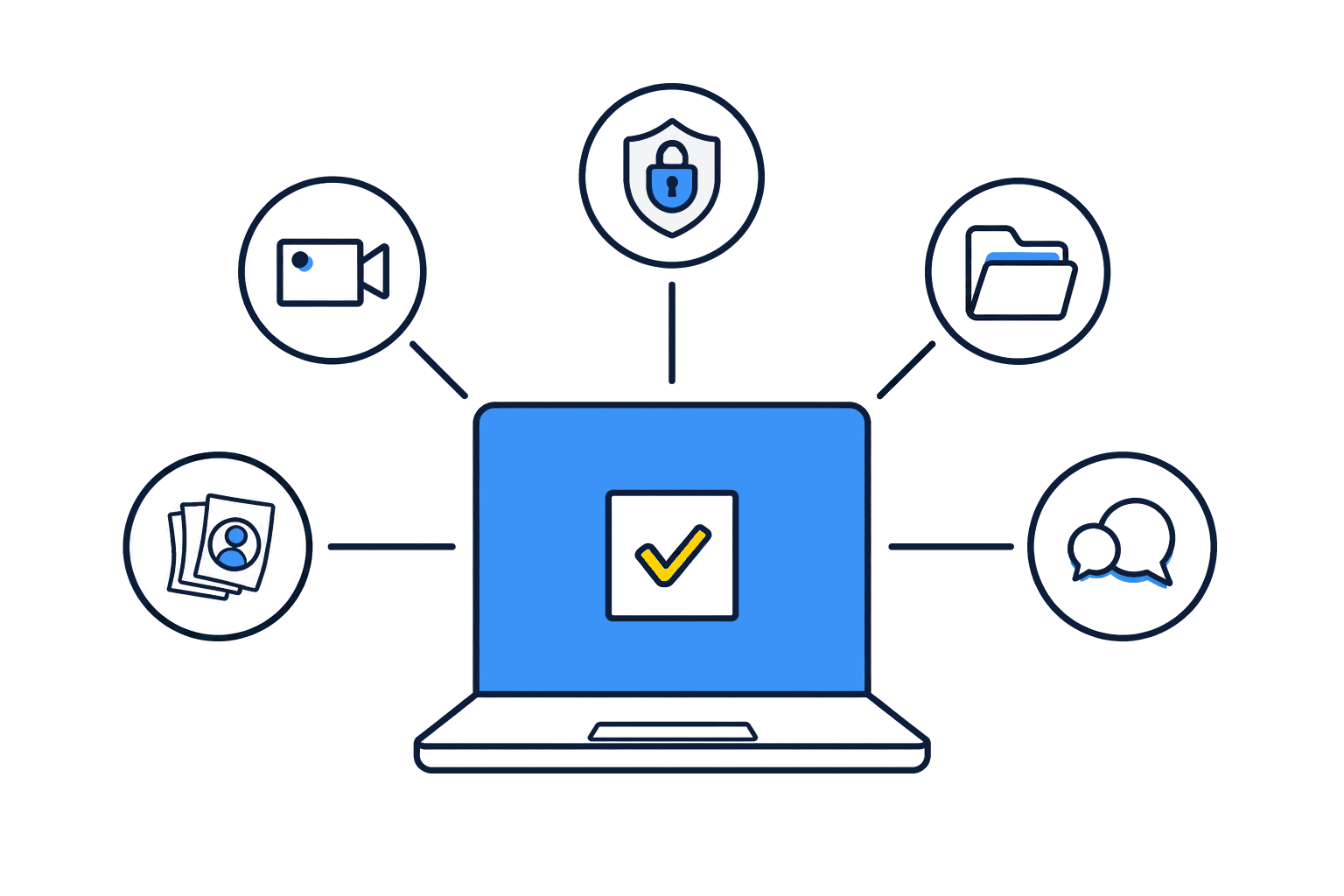
Stackfield shows what native integration looks like in practice: tasks, chat, video, files, whiteboards, and an office suite all run within a single interface. No context switching, no duplicate data storage, and one point of contact for support that can be reached by phone. This not only reduces software costs but also preserves the hidden currency of modern work: focus time.
Best collaboration tools: why Stackfield stands out as an all-in-one solution
The best collaboration tool is not the one with the most features. It is the one your team actually uses, that protects your data, and that eliminates tool sprawl. Stackfield combines exactly these three dimensions:
- True end-to-end encryption, meaning not even Stackfield itself can access your data.
- A comprehensive all-in-one feature set, from project management to chat to video conferencing.
- An onboarding success team by your side and personal phone support in German.
Efficient project work without tool hopping Why maintain five tools when one can handle everything natively? Bring chat, tasks, and documents together in one place without integration chaos.
Simplify your tool landscape
FAQ
Which collaboration tools are GDPR-compliant?
GDPR compliance requires more than just an EU server location. Key factors include a data processing agreement, encrypted data transmission, no CLOUD Act exposure, and ideally true end-to-end encryption. Tools with German data hosting, such as Stackfield or awork, have clear advantages over US providers like Slack, Asana, or ClickUp.
All-in-one tool or specialized standalone solutions?
The trend clearly points toward consolidation: 61% of organizations are actively reducing their standalone apps. All-in-one platforms lower costs and cognitive load by reducing context switching. Specialized tools still make sense when a specific area has highly advanced requirements, such as professional video editing or complex ERP systems.
How much does a collaboration tool cost for a team of 50 users?
Costs vary widely depending on the chosen tool and any paid add-ons. A stack consisting of Slack, Asana, and Google Workspace can quickly reach several thousand euros per month for 50 users. On top of that, there are hidden costs for add-ons, AI features, and support packages.
Which collaboration tools are suitable for public authorities?
Public authorities require BSI C5-certified solutions with German data hosting and digital sovereignty. Stackfield meets these requirements with BSI C5, ISO 27001, true end-to-end encryption, and German servers. US tools such as Microsoft Teams or Slack are increasingly viewed critically in the public sector due to CLOUD Act exposure. You can find more information in our article "Agile collaboration in administrations".
How do I introduce a new collaboration tool to my team?
Start with a pilot phase in a small group of five to ten people. Appoint champions who drive adoption within the team. Migrate gradually instead of switching everything at once. Use the provider’s personal customer success support—for example, Stackfield offers phone support during the 14-day trial. Practical guidance can be found in onboarding best practices for introducing Stackfield within your organization.