Nursing documentation is scattered across shift handover logs, WhatsApp messages, and disconnected Excel spreadsheets, while the hospital is implementing the KHZG and a medical practice group is opening its third location. Project management tools are supposed to bring this work together, but in healthcare they cannot handle patient data as casually as in other industries. Which tool actually delivers what hospitals, medical practices, and care facilities need?
The topic at a glance
- Data protection is not a nice-to-have: Patient data is subject to medical confidentiality and the GDPR, restricting the choice of tools in healthcare more than in other industries.
- Cross-location collaboration is crucial: Hospitals with multiple departments, medical practices with multiple locations, and care facilities operating in shifts need centralized tools rather than scattered emails and isolated solutions.
- HIS integration is not (yet) a standard feature: None of the four tools compared offers native integration with a hospital information system (HIS); this interoperability is handled separately through HL7 and FHIR standards.
- Stackfield combines everything natively in one application: Stackfield brings tasks, chat, and file storage together in one application, protecting everything with genuine end-to-end encryption and hosting exclusively in Germany.
Less tool chaos for your healthcare team With Stackfield, you bring tasks, team chat, and documentation together in one place, across departments and locations. Genuine end-to-end encryption and hosting in Germany also protect all patient information.
Simplify healthcare project management now
The specific requirements of hospitals, medical practices, and care facilities
Project work in healthcare differs from general project work in one respect that affects everything else: Almost every project involves personal health data. Even internal project content, such as names in task descriptions or minutes from case discussions, is subject to medical confidentiality.
Under Section 203 of the German Criminal Code (StGB) this obligation also extends to everyone involved in processing the data, explicitly including a facility's staff and IT service providers. Introducing a tool means deliberately entrusting this data to a third party.
On top of that, there is an operational reality unlike that of other industries:
- Shift work in nursing: Handovers between day and night shifts, changing project leads, and no stable team throughout the entire project.
- Departments with their own scheduling needs: In hospitals, operating room planning, quality management, and KHZG implementation run in parallel, often without central coordination.
- Multiple locations with shared patient flows: Medical practice groups and organizations operating several facilities need an overview that extends beyond individual locations.
- Quality inspections by the Medical Service: Under Section 114 of Book XI of the German Social Code (SGB XI) care facilities must participate in routine inspections, and special inspections may take place without prior notice. Complete, traceable documentation is a requirement, not an optional extra.
- Staff shortages in nursing and administration: Here, resource planning becomes critical to project success sooner than almost anywhere else.
Which features do healthcare teams really need?
- Centralized task and project management: Deadlines, milestones, and responsibilities in one place, so nothing gets lost between shift handovers. Good task management shows every shift what needs to be done next.
- Visibility across locations: A portfolio overview covering multiple departments, hospital sites, or care facilities operated by one organization, as provided by consistent multi-project management .
- Integrated chat and video conferencing: Questions between departments and case discussions across locations are part of everyday work. Team communication directly within the project management tool eliminates the need for separate messaging apps through which unprotected content might be shared.
- Secure, encrypted file storage: Store meeting minutes, plans, and nursing documentation with genuine end-to-end encryption so that not even the provider can read them.
- Traceable versioning and audit readiness: Every change must be verifiable, which is relevant for Medical Service inspections and ISO certifications.
- Ease of use: Doctors and nursing staff do not have time for lengthy training. A tool that cannot be understood in five minutes will not gain acceptance in day-to-day work.
Comparing the 4 best project management tools for healthcare
Four tools currently best meet the needs of hospitals, medical practices, and care facilities: Stackfield, OpenProject, InLoox, and Projektron BCS. The table highlights the differences in the criteria that matter most in everyday work: integrated group chat for questions across departments and shifts, workflows for structured documentation processes, data storage in Germany and the EU due to confidentiality obligations and the GDPR, and genuine end-to-end encryption as the strictest security criterion.
| Tool |
Integrated group chat & direct messages |
Workflows for documentation processes |
Data stored only in Germany / EU |
Genuine end-to-end encryption |
| Stackfield |
✔ |
✔ |
✔ |
✔ |
| OpenProject |
✖ |
✔ |
✖ |
✖ |
| InLoox |
✖ |
✖ |
✔ |
✖ |
| Projektron BCS |
✔ |
✔ |
✔ |
✖ |
Legend:
✔ = available
✖ = not available
Stackfield: Secure project work for hospitals, medical practices, and care facilities
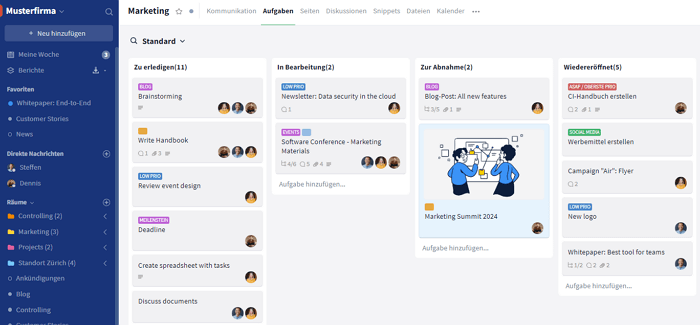
Stackfield is a German project management and collaboration platform that combines tasks, communication, and file storage natively in one application, while protecting all content with genuine end-to-end encryption . Hospitals, medical practices, and care facilities use it for project management in healthcare, recruitment management, and collaboration across locations, with hosting exclusively in Germany.
Strengths:
- Genuine end-to-end encryption and data storage in Germany, ISO 27001 certified and holding the BSI C5 attestation
- Group chat, topic-based discussions, and video conferences integrated natively, with no separate messaging app required
- Time tracking and workflows for structured documentation processes, including shift work
- Portfolio management for the simultaneous coordination of multiple locations and departments
- Data processing agreement under the GDPR can be concluded directly within the tool
- Free 14-day trial, with no sales consultation required
Limitations:
- No native HIS integration; connection via webhooks and the API is possible (from Premium upwards), requires custom development, and works only in unencrypted rooms
- No ready-made project template for healthcare facilities, although custom templates can be created
- At least five licenses required
- Group conferences are available only from the Premium plan upwards
Best suited for: Hospitals, multi-location medical practices, and care facilities that want project management and secure communication in one tool, including smaller care facilities with only a few administrative licenses.
Price: Starter from €9 / user / month (chat, tasks, Gantt); video conferences from Premium (€18 / user / month), minimum five users, free 14-day trial.
OpenProject: Open-source project management for hospital networks
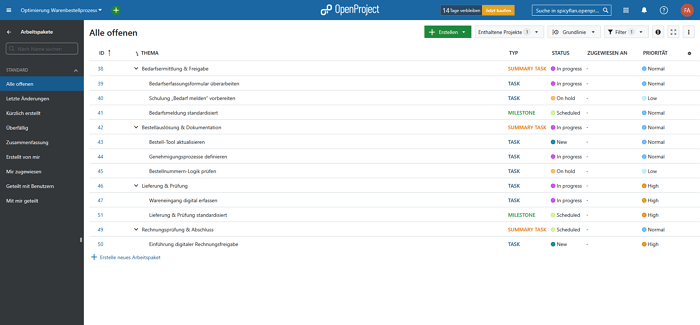
OpenProject is open-source project management software that natively includes Gantt charts, workflows, portfolio management, and wiki pages, among other features.
Strengths:
- Open source with publicly accessible source code
- Workflows, portfolio management, and wiki pages included natively
- Methodology-agnostic, including compatibility with PRINCE2
Limitations:
- No native HIS integration
- No integrated group chat; communication requires a separate third-party solution
- No native audio or video conferencing
- No genuine end-to-end encryption
- Data storage is not inherently restricted to Germany / the EU; the standard cloud runs on AWS, with German hosting available only on request
- Community Edition available exclusively as a self-hosted solution
Best suited for: Hospital networks and care facilities with their own IT teams that want full control over their data through self-hosting.
Price: Basic from €5.95 / user / month with annual billing, minimum 25 users; self-hosting also starts at 25 users.
InLoox: Project management with Outlook integration and a nursing care template
InLoox is project management software from Munich, known primarily for its close integration with Outlook and Microsoft 365. For healthcare, InLoox offers a free planning template specifically for selecting and implementing a nursing documentation system.
Strengths:
- Company headquarters and data storage in Germany and the EU
- Free planning template for implementing a nursing documentation system
- Extensive file management and Office integration via Outlook and Microsoft 365
- Comment-based project communication with automatic notifications
Limitations:
- No native HIS integration
- No workflow functionality for automated documentation processes
- No native calendar
- No native audio or video conferencing
- No genuine end-to-end encryption
Best suited for: Teams that already work extensively with Outlook and Microsoft 365 and are looking for a ready-made template for projects such as introducing a nursing documentation system.
Price: On request; cloud from 5 users, self-hosted from 20 users.
Projektron BCS: ERP and project management for large hospital networks
Projektron BCS is project management software from Berlin that combines project management with ERP functions such as invoicing, a ticketing system, and resource management. The tool is ISO 27001 certified, operates its data center in Germany, and is used by organizations including University Medical Center Freiburg, Klinikum Nürnberg, gematik, and IQTIG.
Strengths:
- Company headquarters and data storage in Germany and the EU, ISO 27001 certified, data center in Germany
- Group chat, direct messages, and topic-based discussions integrated natively
- Workflows, portfolio management, file management, and Office integration
- Methodology-agnostic: PRINCE2, Scrum, and waterfall are supported
- Advanced ERP functions for billing, ticketing, and resource management
Limitations:
- No native HIS integration
- No native audio or video conferencing
- No wiki pages
- No genuine end-to-end encryption
- More complex licensing model, greater implementation effort for large deployments
Best suited for: University hospitals and large hospital networks that want to closely integrate project management with billing, ticketing, and resource planning.
Price: On request.
Expert tip: Compare the licensing model against your shift patterns. When team sizes fluctuate significantly due to rotations, project teams, and night shifts, it is worth looking at the billing model: some providers charge by fixed user accounts, while others, such as Projektron BCS, charge based on concurrent logins within a 24-hour period. This can save costs in shift-based operations, but it needs to be calculated carefully for the specific usage scenario.
What hospitals, medical practices, and care facilities should consider when choosing a tool
- Data protection and server location: Patient-related project content, such as names in tasks or internal minutes, is subject to confidentiality obligations under Section 203 of the German Criminal Code (StGB). Genuine end-to-end encryption and data storage in Germany or the EU are therefore fundamental requirements for production use.
- Collaboration across locations: For organizations operating multiple hospitals, medical practices, or care facilities, what matters is how well a tool supports portfolios and handovers between departments without losing information at the interfaces.
- Integration into the existing IT environment: Because none of the four tools integrates natively with a hospital information system, the openness of their interfaces to complementary systems is crucial. According to gematik , interoperability with hospital applications relies on the HL7 and FHIR standards. A project management tool complements this layer but does not replace it.
- Implementation effort and ease of use: Nursing staff and doctors have little time for training. An accessible introduction, such as the department-by-department rollout at St. Josefs-Hospital Wiesbaden, is often decisive for acceptance in everyday work.
- Licensing model and scalability: Shift-based operations and changing project teams require a licensing model that scales with actual usage.
The benefits of a centralized project management tool in healthcare at a glance
- Complete documentation for Medical Service quality inspections: Under Section 114 of Book XI of the German Social Code (SGB XI) , the Medical Service reviews nursing documentation in care facilities. A central history of tasks and meeting minutes replaces loose handover notes with traceable entries.
- Legally compliant project documentation: Under Section 630f of the German Civil Code (BGB) , healthcare practitioners must document treatment promptly and in a manner protected against falsification in a patient record. Projects such as implementing a nursing documentation system also benefit from a documentation culture with versioning rather than loosely stored files.
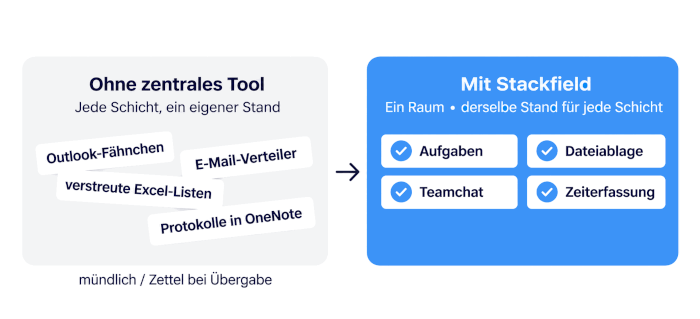
- Less information loss between day and night shifts: A centralized task handover replaces verbal handovers and paper notes, so every shift starts with the same up-to-date information.
- Faster decisions on time-critical projects: Across multiple departments or locations, for example in construction projects while a hospital remains operational, decisions and questions are kept in the same workspace instead of separate inboxes.
- Better resource planning despite staff shortages: Time tracking and departmental utilization show where bottlenecks are emerging before they put projects at risk.
Project management in healthcare: Secure and uncompromising with Stackfield
Hospitals, medical practice groups, and care facilities face the same challenges: projects span departments and shifts, documentation must remain traceable at all times, and patient data must never end up on insecure servers. Most tools solve one of these problems but fall short on the others.
Stackfield combines project management, team communication, and secure file storage in one application, with genuine end-to-end encryption and hosting exclusively in Germany. For facilities unwilling to compromise between functionality and data protection, that is the decisive difference.
Collaborate securely, keep projects under control Stackfield brings tasks, communication, and documentation for hospitals, medical practices, and care facilities together in one place, with genuine end-to-end encryption and hosting in Germany.
Start your free 14-day trial now
FAQ
Is direct HIS integration available in project management tools for hospitals?
No. None of the four tools presented offers native integration with a hospital information system. Interoperability between hospital applications is based on standards such as HL7 and FHIR, which gematik coordinates as part of the ISiK program for hospital information technology. A project management tool complements the HIS when organizing projects but does not replace it: patient care and project administration remain separate systems with separate sets of data. Anyone wishing to connect the two should clarify before implementation which interfaces and export options the project management tool offers for their IT environment.
Are ready-made project templates available specifically for healthcare processes, such as introducing a nursing documentation system?
Yes, but so far only in a few cases. InLoox currently offers a free, industry-specific template for selecting and implementing a nursing documentation system. General project management tools such as Stackfield, OpenProject, or Projektron BCS instead provide flexible, customizable standard templates that organizations can adapt to their own hospital, medical practice, or care projects. For facilities starting a single, clearly defined project, a ready-made template saves time. For ongoing operations across many projects, what matters more is how quickly teams can create and reuse their own templates.
How does genuine end-to-end encryption work technically when multiple medical practice or hospital locations access a project at the same time?
With Stackfield, each data room is encrypted separately using an automatically generated key. When a new location or person is added to a room, they automatically receive the appropriate key in the background, without anyone having to remember a password or exchange keys manually. This keeps access secure and straightforward across any number of locations. That is what distinguishes genuine end-to-end encryption from transport encryption, under which the provider can process the data in plain text on its server.
Are open-source tools like OpenProject suitable for smaller care facilities as well?
In principle, yes, with two limitations. OpenProject has no integrated communication features, so chat and video conferencing require an additional separate tool, raising the data protection question a second time. And the free Community Edition is available only as a self-hosted solution: facilities without their own IT department have to manage installation, updates, backups, and security themselves, or subscribe to the cloud version. For smaller care facilities without technical staff, this administrative workload is often the decisive factor rather than the range of features.
Does Stackfield conclude a data processing agreement as required under the GDPR when handling patient or resident data?
Yes. The data processing agreement required under the GDPR can be concluded in Stackfield directly, with just a few clicks. For hospitals, medical practices, and care facilities that have personal data processed by an external service provider, this agreement is a prerequisite before production use. Involving the facility's data protection officer before making a decision allows the agreement to be reviewed together with the certification documents.