Five browser tabs, one task: The discussion happens in a chat tool, the status is buried in a spreadsheet, the deadline is in another app's calendar, and the file is stored in a cloud service that not everyone can access. It's moments like these that make you realize your team's work is spread across too many applications, leaving no one with a complete overview. A work management tool solves this problem by bringing projects, processes, and communication together in one place.
The essentials at a glance
- Overview: A work management tool brings projects, ongoing processes, and routine tasks together across teams in one platform. Unlike traditional project management, work management is continuous and doesn't have a fixed end date.
- Use cases: From public administration and healthcare to agencies and product teams, a work management tool is valuable wherever multiple departments or external partners need to collaborate.
- Benefits: Less switching between tools, centralized information, and measurable time savings, with responsibilities and deadlines clearly visible in one place.
- Stackfield: Combines work management, project management, and team communication natively in one application, including true end-to-end encryption and German data hosting, without compromising on functionality or security.
Put an end to tool chaos in your team Stackfield brings project management, team communication, and file storage together natively in one application, with true end-to-end encryption and servers located in Germany. Your team can work together in one place without compromising on security or functionality.
Say goodbye to tool chaos
Work Management Tools: Definition and Key Differences
When multiple departments, ongoing processes, and changing projects are all running simultaneously, a simple task list is no longer enough. Even a traditional project management tool with a fixed end date falls short when the work itself never really stops: Processes continue, routine tasks recur, and collaboration extends across departmental boundaries. A work management tool fills exactly this gap. Here's how it differs from related concepts:
| Concept |
Focus |
Time frame |
| Work Management |
Cross-team coordination of projects, ongoing processes, and routine tasks |
Continuous, with no fixed end date |
| Project Management |
An individual project with a clearly defined objective |
Time-limited, with a defined end date |
| Task Management |
Individual operational tasks: Who does what, and by when? |
Short-term, task-specific |
Work management goes beyond individual tasks or projects. It coordinates collaboration across all types of work, continuously and across departments. For teams that currently switch between project management software, chat tools, and file storage solutions, this is the key difference.
The key benefits of a work management tool
- Less switching between tools. According to the MaibornWolff Technology Efficiency Study 2026 (in German, based on a survey of 305 IT decision-makers), 61% say overly complex software reduces their productivity. In addition, 41% use software whose features are already covered by another tool within their organization. Every unnecessary application comes at a double cost: licensing fees and lost focus.
- Less time lost to context switching. A study featured in Harvard Business Review (covering 20 teams and 137 employees at three Fortune 500 companies) found that employees switch between applications approximately 1,200 times per day on average. That adds up to almost four hours per week, or around 9% of the working week.
- Centralized information and clear responsibilities. Instead of piecing together information from chats, emails, and spreadsheets, everyone can find the latest updates directly in the relevant task, project plan, or discussion thread.
- Faster onboarding for new team members. New hires can find all projects, discussions, and files in one place, allowing them to get up to speed faster without requesting access to five different applications or learning five separate interfaces.
Tip: Before introducing a new tool, take a quick look at your team's existing software stack. Which applications overlap in functionality? If your team currently uses three separate tools for project management, communication, and file management, you can often consolidate them into a single platform like Stackfield. This gives you an immediate, clearer overview without adding unnecessary complexity.
What are the best use cases for a work management tool?
The more departments, external partners, and regulatory requirements are involved, the more important it becomes to have a shared platform instead of a patchwork of separate tools. What a work management tool like Stackfield needs to deliver in practice depends on the specific use case, as requirements can vary significantly across industries and organizations.
Public administration and critical infrastructure (KRITIS)
For public authorities and critical infrastructure (KRITIS) operators, German data hosting and verifiable certifications are essential requirements, not just nice-to-have features. This is also reflected in Myra Security's "State of Digital Sovereignty 2025" report: 84.4% of IT decision-makers favor prioritizing European digital products for critical infrastructure.
A real-world example illustrates this: BRK Emergency Medical Services uses Stackfield to coordinate IT projects, procurement, and quality management across eight dispatch centers throughout Bavaria.
"We needed a digital system that would allow us to collaborate across teams, meet the fundamental data protection requirements in Germany, and help us keep track of our extensive workload."
Michael Höhnel, BRK Emergency Medical Services
The key difference lies in access management: External collaborators can be invited directly into projects with limited permissions, without the hassle of managing accounts across multiple systems.
Healthcare
Medical centers and healthcare facilities also handle highly sensitive data. Medizentrum Eckert, which has around 500 employees, uses Stackfield as its central collaboration platform, with 65% of its workforce actively using it. Two features in particular drive adoption: global search and centralized file management. Patient information and documents are no longer scattered across email inboxes but can be found directly where the work happens.
Agencies and product development
Agencies and product teams often coordinate client-facing deadlines across multiple departments. .diff communications uses centralized project workspaces in Stackfield to manage client projects, involving internal teams, clients, and external service providers as needed. This ensures that tasks, responsibilities, and project progress remain transparent and easy to track at all times. Instead of piecing together information from different tools and email threads, everyone involved can find the latest updates in one place.
Small teams and growing businesses
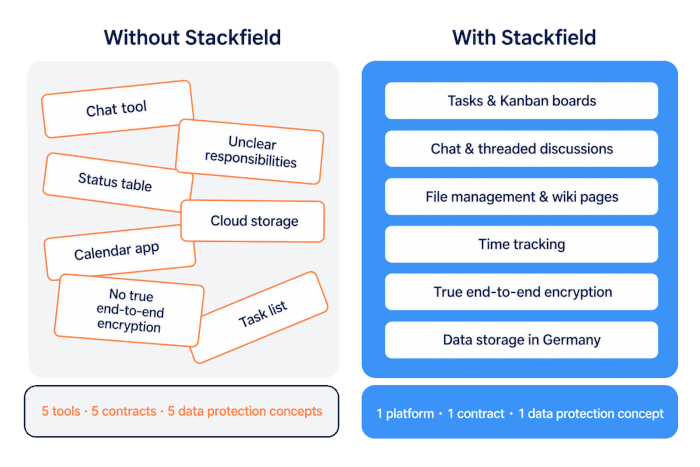
Even without strict compliance requirements, consolidating tools can be worthwhile for teams with just a handful of employees. Stackfield's licensing starts at five users, and the Starter plan includes chat, task management, Kanban boards, and time tracking. Teams currently using three separate solutions can bring their collaboration together in one platform while also reducing the number of contracts and potential data protection risks.
What to look for when choosing a work management tool
Not every tool marketed as a work management solution meets the same requirements. In practice, four key criteria determine whether implementation will be successful or the tool will quietly be abandoned after six months.
- Range of features: Does the tool natively support project management, communication, and file management, or does each function require a third-party integration? Every additional integration means another contract, another potential data protection risk, and more time spent switching between tools in your daily work. The Stackfield feature overview, for example, shows how Kanban boards, Gantt charts, video conferencing, and file management work together in a single application.
- Data protection and data sovereignty: When choosing a tool, look for true end-to-end encryption, data hosting in Germany, and subcontractors based exclusively in Germany or the EU. This helps you maintain full control over your data and ensure GDPR-compliant collaboration.
- Certifications: Which certifications and compliance credentials matter for your industry? In sectors handling sensitive information, BSI C5 attestation, ISO 27001 certification, and ISO 27017 and ISO 27018 certifications are established ways to demonstrate that a provider follows verifiable security processes. Organizations subject to DORA or NIS2 requirements should assess a provider's compliance before making a decision.
- Ease of use and implementation effort: If an application creates problems, it can throw your team's schedule off track. New project participants need to get up to speed quickly, especially since projects lasting several weeks or months often involve new employees or temporary collaborators. Before making a decision, test the tool with your team to see how quickly everyday tasks can be completed without training and whether it supports your existing workflows without forcing you to introduce new processes.
Stackfield: Your work management tool from Germany, without compromise
Stackfield brings everything teams need for their daily work together natively in one application, without compromising on functionality or data security.
Features at a glance:
- Project management with task management, Kanban boards, Gantt charts, network diagrams, time tracking, and capacity planning
- Native team communication: Chat, threaded discussions, and one-on-one calls with audio, video, and screen sharing
- File management and wiki pages for knowledge management
- From Premium onwards: Whiteboards, project portfolios, and group video conferences with up to 30 participants
Stackfield also stands out when it comes to security and compliance: True end-to-end encryption, data hosted exclusively on servers in Germany, and subcontractors based only in Germany or the EU. Stackfield holds ISO 27001, ISO 27017, and ISO 27018 certifications, as well as BSI C5 attestation.
And the customer service matches the quality of the platform: German-speaking support, a dedicated contact person, and a comprehensive Learning Center. No long waiting times.
Tip: Start small. Introduce Stackfield in one team or department first, for example, for an ongoing project with a clearly defined scope. Once the workflow is running smoothly, expand its use across departments. This keeps implementation manageable and allows your team to build confidence through early successes before rolling it out to other areas.
Work management with Stackfield: Why consolidation pays off
Fewer tools mean better visibility, clearer responsibilities, and less friction. If your team currently uses three different applications for project management, communication, and file management, you're paying for that fragmentation in three ways: licensing costs, data protection risks, and lost focus.
Stackfield proves that consolidation doesn't have to mean compromise. One application replaces a patchwork of separate tools while providing true end-to-end encryption, German data hosting, and a comprehensive range of features. Want to see the benefits for yourself? Try Stackfield free for 14 days, with no credit card and no contract required.
Project management, communication, and security: All in Stackfield Stackfield brings everything teams need to get work done together in one application, with true end-to-end encryption and servers located in Germany. That means you stay in control of both your projects and your data.
Try Stackfield for free
FAQ
Which work management tool meets the requirements of critical infrastructure (KRITIS) operators?
Critical infrastructure (KRITIS) operators should require, at a minimum, BSI C5 attestation and ISO 27001 certification, along with data hosting in Germany and subcontractors based exclusively in Germany or the EU. The software must be able to demonstrate compliance with current technical standards, including requirements under NIS2 and Germany's KRITIS umbrella legislation. One real-world example is BRK Emergency Medical Services, which uses Stackfield to coordinate cross-team IT projects across eight dispatch centers.
At what team size does a work management tool become worthwhile?
The benefits depend less on team size than on how work is distributed. As soon as multiple people collaborate on the same projects and processes and need to share information, a centralized platform becomes valuable. Stackfield's licensing starts at five users, making it suitable for small, growing teams even without strict compliance requirements. The main advantage is consolidation: Tasks, chat, and files are all managed in one application, eliminating the separate contracts, costs, and data protection risks associated with individual tools.
When should you switch from project management software to a work management tool?
Traditional project management software is designed for time-limited projects with clearly defined goals and end dates. But when teams also need to manage ongoing processes, routine tasks, and cross-departmental coordination, its limitations become apparent. A work management tool supports continuous operations. Procurement, quality management, and everyday workflows remain on the same platform even after individual projects have been completed.
Which certifications should a work management tool have for industries handling sensitive data?
The foundation includes ISO 27001 certification for information security management and BSI C5 attestation for cloud services in the German market. ISO 27017 and ISO 27018 certifications provide additional assurance regarding cloud security and data protection. Organizations subject to regulatory requirements should also assess compliance with DORA and NIS2. One real-world example is Medizentrum Eckert, a healthcare provider with approximately 500 employees that actively uses Stackfield in its daily operations.
What makes Stackfield stand out as a work management tool?
Stackfield brings project management, communication, and file management together natively in one application, protecting all content with true end-to-end encryption. Data is hosted on servers in Germany, subcontractors are based exclusively in Germany or the EU, and Stackfield's security credentials include ISO 27001, ISO 27017, and ISO 27018 certifications, as well as BSI C5 attestation.