An IT decision-maker is evaluating enterprise project management software for 500 employees. The business department requires a broad range of features, portfolio visibility, and scalability. The legal department requires a current BSI C5 attestation and complete documentation of data processing. Meeting both requirements at the same time often seems like a compromise between convenience and control. Yet many companies still evaluate enterprise project management software primarily based on its range of features rather than its auditability. Ultimately, this order of priorities determines whether a tool can be used at all in the public sector or regulated industries.
The essentials at a glance
- Certification is essential: ISO 27001 and a BSI C5 attestation are becoming fundamental requirements for enterprise project management software in the public sector and KRITIS-related industries.
- Server location alone does not provide protection: For legal certainty, what matters is which jurisdiction the provider is subject to, not where the servers are physically located.
- Tool sprawl costs more than license fees: Unused and functionally overlapping SaaS licenses tie up budget and create additional administrative work for the IT department.
- Stackfield combines these requirements: Stackfield brings task management, team chat, and video conferencing together with ISO 27001, BSI C5, true end-to-end encryption, European data hosting, and a choice of cloud or self-hosted deployment in one platform.
Enterprise software that combines functionality and compliance
Stackfield meets the certification and legal requirements of your IT and legal departments without compromising on functionality.
Get started without compromise
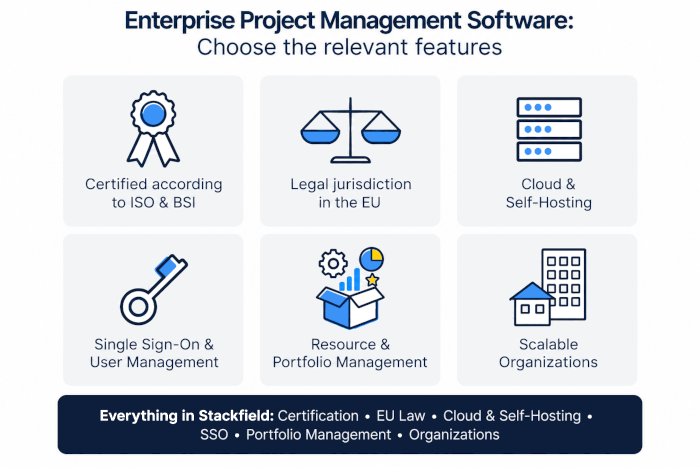
Enterprise project management software: Certification, legal jurisdiction, and hosting options
Enterprise Project Management strategically aligns projects across multiple departments and locations with business objectives, rather than focusing solely on the execution of individual projects. For organizations with more than 50 employees, in the public sector, or in regulated industries, a second criterion is equally important: proof that the software meets security and compliance requirements.
Regulations such as NIS2, the KRITIS Umbrella Act, and the IT Security Act 2.0 have significantly tightened these requirements since 2025. Proof of certification and legal jurisdiction therefore determine whether a tool can be approved for enterprise use at all.
ISO 27001 vs. BSI C5: What enterprises need to know
According to the BSI, a certification involves three parties: the audited organization, the auditor, and a separate certification body. An attestation, by contrast, is issued directly by the auditor without an intermediary certification body. ISO 27001 and BSI C5 complement each other rather than being mutually exclusive.
The C5 criteria catalog builds on the fundamental principles of ISO/IEC 27001 and adds cloud-specific requirements. An ISO 27001 certificate primarily demonstrates that a provider manages its information security in a structured manner. On its own, however, it does not indicate whether this level of security is sufficient for a specific cloud use case. In the public sector, a clear distinction has therefore become established:
- ISO 27001: is now considered a standard requirement for cloud software.
- BSI C5 attestation: is required in addition to ISO certification, particularly at the German federal level.
Enterprise buyers should therefore request both forms of evidence rather than relying on a single certification or attestation.
US CLOUD Act: The role server location really plays
A common misconception is that a European data center automatically protects data from access by US authorities. This is not the case if the provider itself is a US company. What determines whether the US CLOUD Act applies is the provider's legal jurisdiction, not the physical location of its servers. A provider headquartered in Europe, with data processing in Europe and exclusively European subcontractors, is not subject to this type of access in the first place.
Enterprise buyers should evaluate this question separately from encryption technology. Whether a provider is subject to the US CLOUD Act depends on its headquarters and subcontractors, not on the technical safeguards used to protect the data.
Hosting options and enterprise administration
Enterprise-ready software should be available both as a cloud solution and for self-hosting. With the cloud option, the provider takes full responsibility for operation and maintenance. With self-hosting, the company itself is responsible for setup and ongoing maintenance, which requires additional internal IT resources. Self-hosting is particularly worthwhile for organizations that need complete control over their infrastructure, but it is not a general recommendation for every enterprise.
Organizational control also requires administrative features that IT departments should actively request during the evaluation process:
- Single sign-on via Active Directory integration
- Centralized management of multiple sub-organizations
- User account provisioning via API
- Exportable access and activity logs that make it possible to track changes and logins
Enterprise project management software: The right features make the difference
What distinguishes enterprise project management software from a simple team tool is whether multiple projects, departments, and locations can be viewed and managed simultaneously. Two areas of functionality are particularly important when determining whether a solution is enterprise-ready.
1. Portfolio and resource management across multiple departments
Individual teams can often manage with a Gantt chart or a Kanban board for each project. Enterprise organizations with several projects running in parallel also need a portfolio view that reveals dependencies and resource conflicts across departments before they become a problem. Without this visibility, project managers often do not identify capacity issues until deadlines are already at risk.
2. Scalability for large teams without performance issues or permission management chaos
As the number of users grows, so does the complexity of the organizational structure. Multiple locations, departments, or subsidiaries often need their own areas within the same platform. Enterprise-ready software needs to support sub-organizations and granular role and permission models so that administration does not become a full-time job, while a central parent organization can still maintain an overview.
Tool consolidation: What tool sprawl really costs enterprises
Tool sprawl usually results in a gradual loss of control. Over time, each department introduces its own tools until tasks, communication, and files are spread across multiple platforms. This costs more than additional license fees; it creates a real governance burden for IT.
Current market observations show just how significant this burden can be: A substantial share of the SaaS tools licensed by companies goes unused or overlaps in functionality with existing software, often without the IT department even being aware of it. For many organizations, this is exactly what prompts them to actively consolidate their tool landscape rather than continually adding new standalone solutions.
A consolidated platform makes this overhead visible and easier to reduce: fewer integrations, fewer individual contracts, and centralized user management instead of five separate systems.
Good to know: Before your next contract renewal, it is worth taking a quick inventory: Which tools serve the same purpose, which integrations require additional security measures, and which licenses were actually used during the last quarter?
Enterprise project management software with Stackfield: Certified, legally compliant, and flexible hosting
Stackfield brings task management, team chat, video conferencing, file management, and a collaborative office suite together in one platform while also meeting key security requirements (ISO 27001 certified, BSI C5 attested, true end-to-end encryption, data processing on German servers under German law, and an Enterprise plan with unlimited sub-organizations and single sign-on).
Three enterprise use cases show how this combination works in practice:
- Cross-departmental project management: Multiple projects running in parallel, for example in procurement, IT, and quality management, are managed within a shared structure using portfolio views and sub-organizations instead of separate tool silos for each department.
- Secure rollout in the public sector or regulated industries: Certification requirements and German legal jurisdiction are already covered when a government agency or KRITIS-related organization rolls out the platform, without IT and legal teams having to verify these requirements separately first.
- Consolidation of shadow IT: If departments have introduced their own tools for chat, files, or video conferencing over the years, a platform that provides all the required features can replace this shadow IT landscape instead of adding yet another standalone tool.
This is exactly why enterprises prefer an all-in-one tool over a collection of specialized solutions: Every additional application means another contract, another set of permissions to manage, and another attack surface that the IT department needs to secure. A consolidated platform reduces this overhead without compromising on the features teams need.
For Stackfield, the principle is project management without compromise: functionality and verifiable compliance do not have to be mutually exclusive.
Checklist: How IT decision-makers should evaluate enterprise project management software
The following questions summarize the criteria covered in this article in a practical checklist:
- Is there a current BSI C5 attestation or ISO 27001 certification, and what exactly is its scope?
- Which jurisdiction is the provider subject to, and where are its subcontractors based?
- Does the software support single sign-on and multiple sub-organizations under a central parent organization?
- In addition to the cloud version, is self-hosting available if required?
- Does the software support portfolio and resource management across multiple departments, rather than just individual projects?
- How many of the standalone tools currently in use could be replaced by a consolidated platform?
Enterprise project management software: With Stackfield, verifiable compliance matters just as much as functionality
Whether software is truly enterprise-ready depends on the ability to demonstrate security and compliance to auditors, regulatory authorities, and the company's own legal department. Certification, legal jurisdiction, relevant features, and a consolidated platform are closely interconnected and cannot be evaluated independently of one another.
With Stackfield, enterprises do not have to choose between these requirements: Project management without compromise means getting both functionality and auditability in one solution. Organizations looking for enterprise project management software should make this a key criterion in their selection process.
Certification, legal certainty, and functionality in one platform Choose an enterprise solution that meets your compliance requirements without forcing your team to compromise on functionality.
Meet your enterprise requirements now
FAQ
Is ISO 27001 certification sufficient for public-sector contracts in Germany?
ISO 27001 is now considered a standard requirement for cloud software in the public sector and is explicitly required by most contracting authorities. At the German federal level, a current BSI C5 attestation is often required in addition because the C5 criteria catalog covers cloud-specific requirements that go beyond ISO certification alone. Providers that can provide both forms of evidence reliably cover the common requirement profiles in the public sector.
Why doesn't a German data center alone protect against the US CLOUD Act?
The US CLOUD Act is based not on the location of the servers, but on the legal jurisdiction of the company operating the software. If the provider is a US company, it could theoretically be required to disclose data even if that data is physically stored in a German data center. Only a provider headquartered in Europe and using exclusively European subcontractors is not subject to this type of access in the first place.
Which companies actually need an on-premises deployment of enterprise PM software?
Self-hosting is particularly worthwhile for organizations that need complete control over their technical infrastructure, for example because internal security policies or particularly high protection requirements demand it. For most enterprises, a cloud solution with the appropriate certifications is sufficient, as the provider takes care of operation and maintenance. Self-hosting is therefore a useful option for specific cases rather than a general recommendation for every company.
Which enterprise administration features do IT departments expect from project management software?
IT departments most frequently cite single sign-on via Active Directory integration and the ability to centrally manage multiple sub-organizations under a parent organization as reasons for moving to an enterprise plan. Other commonly requested features include user account provisioning via API, organization-wide export options for settings and member lists, and exportable access and activity logs.
How many SaaS tools can realistically be eliminated with a consolidated enterprise platform?
There is no one-size-fits-all figure, as the number of tools in use varies significantly from one company to another. In practice, however, a similar pattern emerges time and again: A noticeable share of SaaS licenses covers functionality that is already provided by another tool in use. A structured inventory before the next contract renewal can reveal this potential for savings, even without a company-specific benchmark.