Stackfield for public administration
- BSI C5 attested
- German servers
- True end-to-end encryption
Try it for free now
The essentials at a glance
- Compliance as a knockout criterion: GDPR and the German Federal Data Protection Act are mandatory. US tools partially meet these requirements, but are criticized from a data protection perspective due to potential data transfers to third countries and US access rights.
- All-in-one reduces complexity: One platform instead of five separate tools simplifies not only daily work but also compliance checks, one data processing agreement instead of several. All-in-one tools are the future here.
- Clarify procurement law early: Depending on the contract value, a direct award may be sufficient or procurement regulations up to EU-wide tenders may apply. The procurement office should be involved from the beginning.
- Change management determines success: Start with a pilot project in one department, involve the staff council, ensure low barriers to entry in usability, and give employees a dedicated space during the first two weeks to explore the tool. Change management tools can support this process.
- Stackfield as a secure solution: Combines project management, team communication, video conferencing, and file management with true end-to-end encryption, BSI C5 attestation, and ISO 27001 certification.
Imagine this: a project manager in a city administration is tasked with coordinating an digitalization project. Dozens of stakeholders, tight deadlines, coordination across departments. The reality? Excel spreadsheets as project plans, endless email threads, and no clear overview of task status. How can a public authority find a project management tool that not only delivers on functionality but also meets GDPR, BSI C5, and digital sovereignty requirements? This guide provides a checklist for selection, with Stackfield as a benchmark showing what level of requirements can realistically be met today.
What project management software must deliver for public administration
Public administration operates within a framework unlike that of any startup or corporation:
- Legal requirements such as GDPR, the German Federal Data Protection Act, and the E-Government Act set strict limits for any software decision.
- Hierarchical organizational structures with defined chains of command and authority shape daily work.
- Staff councils, data protection officers, and equal opportunity officers must be involved in the decision-making process for project management software.
Public authorities cannot simply choose the next available tool from an app store. Every selection is a formal process with clearly defined requirements.
In practice, the reality in municipalities and state authorities is often sobering:
Email chains replace structured coordination, Excel spreadsheets serve as project plans, and there is no real transparency regarding the status of individual tasks. In Aschaffenburg, the head of the civil engineering department described the email chaos as a "ping-pong game that is simply unbearable". In Nuremberg, the work areas of individual colleagues were "almost like a black box" to others, and in cases of illness, staff first had to search through filing cabinets.
At the same time, the pressure to digitize is increasing significantly. The Online Access Act covers 575 administrative services, of which only 196 have been fully digitized so far. Combined with growing remote work requirements, this creates the need for a solution that finally makes project work structured and transparent.
What further increases the complexity is that, in public administration, the group of stakeholders extends far beyond the internal team. Government representatives, political opposition, civil society groups, and citizens all have legitimate interests in project outcomes. Every decision must be documented in an audit-proof manner: who decided what, when, and why. These requirements for transparency and traceability go far beyond what is typical in the private sector. This is exactly why a structured checklist is needed to select the right project management software for the public sector.
"We know the reality in public administration: the pressure to digitize is increasing, budgets are tightening, and at the same time data protection officers, staff councils, and procurement departments must all be involved. We did not develop Stackfield despite these requirements, but specifically for them, as a German tool that combines BSI C5, true end-to-end encryption, and the full feature set for modern administrative work in a single platform"
Cristian Mudure, Stackfield CEO
Checkliste: Selection criteria for a project management tool in the public sector
The selection of project management software for public authorities can be divided into three categories: data privacy and compliance, functionality with administrative relevance, and organizational requirements. These criteria should be evaluated based on the specific use case and level of data sensitivity, as they determine whether a project management tool is suitable for the public sector.
| Category |
Criteria |
| Data privacy & compliance |
GDPR compliance, German Federal Data Protection Act, BSI C5 attestation, server location in Germany, data processing agreement available, true end-to-end encryption |
| Features |
Gantt charts, Kanban boards, budget planning, project portfolios, team communication, video conferencing |
| Organization |
Procurement law clarified, ease of use, change management, personal support |
GDPR BSI C5 and digital sovereignty as knockout criteria
Any project management software used in the public sector must meet strict compliance requirements and provide a high level of security. This includes:
- full GDPR compliance
- compliance with the German Federal Data Protection Act
- a verified server location in Germany
- a data processing agreement ready to be concluded
In addition, the tool should have BSI C5 attestation. This catalog of criteria from the German Federal Office for Information Security defines minimum requirements for secure cloud computing and provides reliable guidance for public authorities when selecting providers. Equally important is true end-to-end encryption, ensuring that even the provider cannot access stored data.
This is exactly where well-known US project management tools such as Asana, Trello, or monday.com fall short. They do not offer German server locations, lack BSI C5 attestation, and involve data transfers to third countries. A concrete example is the case of Waiblingen. The city initially used Trello but had to review and reduce information before storing it because GDPR compliance was not ensured. This significantly disrupted workflows.
For public authorities that pursue digital sovereignty as a strategic goal, such dependencies are not acceptable. The German federal government has established digital sovereignty as a guiding principle, and any software procurement must reflect this in practice.
| Requirement |
Why is it relevant? |
Typical issue with US tools |
| GDPR compliance |
Legal requirement for any data processing in public authorities |
Data transfers to third countries without adequate protection |
| BSI C5 attestation |
Proof of secure cloud infrastructure according to German standards |
No BSI C5 attestation available |
| Server location in the EU |
Increases legal control and data sovereignty |
Servers in the US or Ireland, with possible access by US authorities |
| Data processing agreement |
Legal basis for processing personal data by third parties |
Often only available on request, not tailored to EU requirements |
| True end-to-end encryption |
Ensures that even the provider cannot access content |
Encryption only in transit, provider can access data |
Project management features tailored to public administration
Public authorities do not need abstract feature lists, but project management capabilities that directly map to their daily operations. What matters is whether a tool supports typical requirements for planning, execution, and documentation across departments and specialized units:
- Gantt charts for project plans with milestones, dependencies, and clear responsibilities.
- Kanban boards for task management in departments, from requirements analysis to implementation.
- Budget planning for transparent management of public funds within individual projects.
- Project portfolios for an overview of multiple digitization projects running in parallel.
- Thread-based discussions for audit-proof documentation of decisions, traceable and centralized.
- Integrated audio / video conferencing without third-party tools, directly within the platform.
An all-in-one platform like Stackfield combines exactly these features with integrated team communication, video conferencing, and file management. This replaces the typical patchwork of individual tools in public administration and significantly reduces compliance effort, one data processing agreement instead of five separate contracts for five different software solutions.
Procurement law when selecting project management software
A topic that few providers address, but which is crucial for public authorities, is procurement law. Depending on the contract value, different procurement procedures apply. The following guidelines provide an initial orientation (without constituting legal advice) for Germany:
- Direct award below country-specific thresholds (which vary by federal state) is the fastest way to procure software
- Negotiated procedure under national thresholds based on procurement regulations, a formalized process without EU-wide publication.
- EU-wide tender above current EU thresholds, requiring a full procurement procedure.
For SaaS procurement in public administration, the EVB-IT Cloud framework provides a standardized contractual basis for cloud services. These contracts are continuously updated to reflect current requirements.
Tip: Involve the procurement office early and check whether framework agreements through central purchasing bodies are available. This can significantly reduce the effort for subordinate authorities and municipalities.
Ease of use and change management
In public administration, ease of use is not a nice-to-have, it determines adoption and therefore project success. Employees have varying levels of IT skills, devices differ, and project participants frequently change. If a tool has a high barrier to entry, people simply will not use it, no matter how strong its features look on paper.
To ensure a successful rollout of Stackfield, the following measures have proven effective in practice:
- Start the tool rollout with a pilot project in a single department.
- Involve the staff council and data protection officer from the beginning.
- Build key users and digital leaders as multipliers within the team.
- Treat personal vendor support as a key selection criterion.
- Use the free trial period to test team adoption before committing budget.
In Coburg, it proved effective to give employees their own personal space during the first two weeks, allowing them to explore the tool freely, without pressure and without colleagues watching. This helps build trust in the tool before actual team collaboration begins.
In addition to the 14-day trial period, Stackfield offers regular webinars for training and onboarding. This allows the platform to be introduced step by step without switching the entire team at once.
EAnother advantage of Stackfield in a public administration context is its modularity. Teams with less technical experience can start with chat and the mobile app, while other departments can use the full project management functionality at the same time. Everyone starts at the level that suits them, without limiting others.
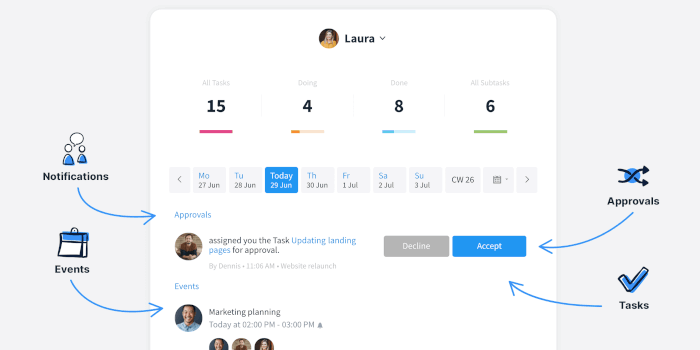
Fewer tools, more clarity: Stackfield for public administration
In many public authorities, the digital workday looks like this: one tool for tasks, another for chat, a third for video conferencing, a fourth for file storage, and email sitting on top as the unofficial central medium. Each of these tools requires its own data processing agreement, a separate data protection review, and individual training for employees. The result is high administrative effort, rising costs, and information silos where knowledge is lost instead of shared.
Stackfield solves exactly this problem.. As an all-in-one platform, it combines project management, team communication, audio and video conferencing, whiteboards, and a collaborative office suite in one central place. At the same time, Stackfield meets the highest security standards with true end-to-end encryption, BSI C5 attestation, ISO 27001 certification, and German servers. Instead of managing five separate solutions, public authorities can consolidate their tool landscape into a single platform – with one data processing agreement, one data protection assessment, and one point of contact at Stackfield.
Try Stackfield free for 14 days
Project management in practice how public authorities use Stackfield
What does usage look like in practice? The following scenarios come directly from everyday administrative work and show how Stackfield addresses typical challenges in municipalities, state authorities, and public institutions:
- OZG implementation: Gantt charts map digitization projects with milestones, dependencies, and clear responsibilities. All stakeholders see the current status in real time without needing email follow-ups.
- IT rollouts: Kanban boards manage tasks during the introduction of new systems. Every phase is visible, from requirements analysis to testing and go-live.
- Cross-department project management: Project portfolios make it possible to manage multiple parallel initiatives centrally, whether building renovations, HR development, or digitization.
- Audit-proof documentation: Thread-based discussions replace confusing email chains. Decisions are traceable, stored in one place, and easily accessible for audits or handovers.
- Integration into existing structures: Stackfield does not replace the document management system but complements it. In Aschaffenburg, information such as offers, plans, and approvals is collected in Stackfield and transferred to the official filing structure at the end of the process. Thilo Vormwald describes Stackfield as part of a "large digital toolbox", not a replacement for existing systems, but the platform where actual project work happens
"Managing projects and communication is something many tools can do. But one thing that immediately stood out with Stackfield was data privacy." This is how a user describes it on the DEUTSCHLAND.DIGITAL marketplace. It is exactly this combination of functionality and security that makes Stackfield a project management solution suited to the needs of public administration.
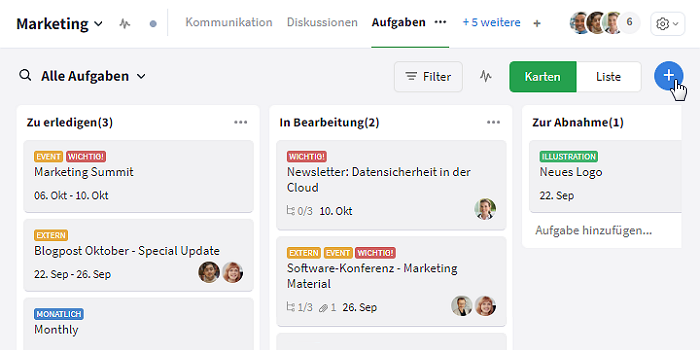
Project management tool for public administration: All-in-one with Stackfield
Stackfield is a German project management solution with a compliance profile that is unique in the market. As a top-ranked all-in-one provider, Stackfield combines BSI C5 attestation, ISO 27001, ISO 27017, ISO 27018, and true end-to-end encryption in a single platform. Not even Stackfield itself has access to your data. The combination of security and functionality is reflected in its ratings: OMR Reviews: 4.8 out of 5, G2 4.3 out of 5, and Capterra 4.8 out of 5.
The following overview shows what Stackfield offers for everyday administrative work:
| Area |
Features |
| Project management |
Kanban boards, Gantt charts, project portfolios, network diagrams |
| Communication |
Team chat, thread-based discussions, audio & video conferencing |
| Document collaboration |
File management, collaborative office suite, whiteboards |
| Control |
Time tracking, budget planning, automated workflows |
Behind the software is a personal customer success support team with phone availability, real people instead of chatbots. Try Stackfield free for 14 days and ideally start with a pilot project in one department before rolling it out across the entire organization.
Test Stackfield in your public authority now Fewer tools, one data processing agreement, full data sovereignty. Bring your digital collaboration under control.
Start your 14-day free trial now
FAQ
What data privacy requirements must a project management tool meet for public authorities in Germany?
Mandatory criteria include GDPR compliance, adherence to the German Federal Data Protection Act, a German server location, BSI C5 attestation for cloud services, and the conclusion of a data processing agreement. Ideally, the tool should offer true end-to-end encryption so that even the provider cannot access stored data.
Do I need a formal procurement process to acquire a project management tool?
This depends on the contract value. Below the specific thresholds of individual federal states, a direct award is often possible. Below EU thresholds, national procurement regulations apply, and above those thresholds, an EU-wide tender is required. Recommendation: involve the procurement office early and check whether framework agreements through central purchasing bodies are available. Expert tip for a fast start: many municipalities such as the city of Nuremberg avoid lengthy organization-wide procurement processes by initially introducing Stackfield through an internal shop system or as individual licenses for pilot departments. This enables an organic rollout as needed instead of forcing a large-scale IT decision all at once.
Which German provider has extensive experience introducing project management tools in public administration?
Stackfield is a German all-in-one platform with many years of experience in the public sector. Personal customer success support, phone availability, and a 14-day trial period enable a risk-free introduction. Ideally, start with a pilot project in a single department.
What are the advantages of an all-in-one solution compared to standalone tools?
One platform instead of five separate tools means one data processing agreement instead of several, a consistent user interface, reduced training effort, and lower IT administration overhead. All information is centrally available instead of being scattered across multiple systems.