Five tools open, three active chats, and the sprint goal still isn't defined. Sound familiar? Sprint planning often gets lost between task management, chat, and documentation before the first task has even been assigned. The problem isn't the methodology but rather the fragmentation of the toolset. This article provides a clear framework for choosing the right tool by combining selection criteria, data protection requirements, and the true cost of ownership. It also positions Stackfield as the German platform for teams that want to manage sprint planning in a structured, secure way without tool sprawl.
The essentials at a glance
- Functional integration: A good sprint planning tool brings together the backlog, team capacity, and communication in one place instead of spreading them across four separate applications.
- Data protection matters: Sprint data often contains personal information. Choosing a tool therefore requires careful GDPR evaluation and offers an opportunity to build data sovereignty into your processes from the outset.
- The true cost: A fragmented stack of Jira, Slack, Confluence, and Miro creates friction and duplicate data maintenance. With Stackfield, everything lives in one room, under a single license, with no hidden add-on costs.
- Stackfield's approach: Sprint backlogs, Kanban boards, time tracking, and communication all come together in one room, protected by true end-to-end encryption and hosted in Germany.
Plan your sprints without switching tools or compromising on GDPR Manage your sprint backlog, communication, and time tracking in a single room with German data hosting and true end-to-end encryption. Run your next sprint planning session entirely in Stackfield with a free 14-day trial. Our Customer Success team will guide you through the initial setup by phone. For organizations with formal procurement processes, personal product demos are also available.
Plan your sprints with confidence
Why sprint planning regularly fails with isolated tools
Overloaded sprints, vague sprint goals, and ineffective planning sessions are rarely the result of poor discipline. More often, they stem from a lack of visibility across the product backlog, team communication, and available capacity. When the development team cannot see its velocity, the Product Owner cannot effectively communicate priorities, and the Scrum Master has no single source of truth to facilitate discussions, sprint planning quickly shifts from defining the sprint goal to debating the current status.
The hidden culprit is the fragmented tool stack: the backlog lives in Jira, discussions happen in Slack, documentation is stored in Confluence, and brainstorming takes place in Miro. Every context switch introduces information loss that no best practice can fully compensate for, as context, estimates, and decisions become scattered across disconnected systems.
Choosing the right sprint planning tool for project management
The right tool is determined less by its feature list than by your specific context. Team size, Scrum maturity, remote collaboration, data protection requirements, and budget all influence what will work best. A distributed team of 30 people in the public sector has very different requirements from a five-person agency. Consider these factors before comparing project management tools.
Three questions can help narrow down your options:
- How many teams will use the tool, and how mature is your Scrum process? A solution that works well for a small development team may quickly become overwhelming across multiple departments.
- Do you want to integrate existing tools such as GitHub or CI/CD pipelines, or is your goal to consolidate your tool stack? This strategic decision fundamentally changes which tools are suitable.
- What is the true cost of your tool stack? License fees are only part of the equation. Context switching between backlog, chat, and documentation as well as maintaining duplicate information across systems also comes at a significant cost.
The following checklist separates functional requirements from organizational ones:
- Functional: sprint backlog with story points, Kanban and list views, Burndown Chart, capacity planning, Definition of Done directly attached to each work item.
- Organizational: integrated team communication, thread-based discussions, centralized documentation linked directly to sprint items.
GDPR-compliant sprint planning as a selection criterion
Backlog items, story points, time tracking, and capacity data all qualify as personal data under Article 6 of the GDPR. Once you process this information in a software platform, you need an appropriate legal basis and a data processing agreement under Article 28 GDPR. Violations may result in fines of up to €20 million or 4% of annual global turnover. Data protection is therefore not an afterthought—it is just as important as features such as sprint backlogs, burndown charts, and velocity tracking.
When evaluating any sprint planning tool, you should verify the following five criteria:
| Evaluation criterion: |
Why it matters |
| Data hosting in Germany / the EU |
Keeps sprint data within the European legal framework |
| EU-based subprocessors |
Prevents uncontrolled data transfers to third-party providers outside the EU |
| True end-to-end encryption |
Protects backlog data even from the service provider itself |
| ISO 27001 |
Demonstrates independently audited information security management |
| BSI C5 |
A key requirement for many public-sector procurement processes in Germany |
Specialized tools vs. all-in-one platforms: The real cost comparison
For a team of ten people, licensing costs add up quickly once you combine specialized tools for task management, chat, documentation, and whiteboarding.
| Tool stack |
Monthly licensing cost (approx.) |
Additional tools required |
GDPR risk |
| Jira Standard |
from $79 / month |
Slack, Confluence, Miro |
US data hosting in the standard plan |
| Monday Pro |
from €190 / month |
Chat tool, whiteboard |
EU hosting only with Enterprise |
| Linear Business |
from $160 / month |
Chat, documentation, whiteboard |
US data hosting |
License fees are only the visible part of the cost. Even more expensive are the constant context switching between the backlog, Slack, and Miro, maintaining duplicate tasks across multiple systems, and uncontrolled data flows between US-based providers. An all-in-one platform reduces this friction while consolidating your data protection framework. The trade-off is that it typically offers fewer developer-specific integrations than engineering-focused tools such as Jira or Linear.
Sprint planning tools compared for German teams
The following overview compares five widely used sprint planning tools based on the criteria that matter most for organizations in Germany.
| Tool |
Sprint planning features |
Integrated communication? |
Data protection & security |
Server location |
Best suited for |
| Stackfield |
Backlog, Kanban, list view, Gantt, time tracking |
Yes, chat, threads, audio & video |
Data Processing Agreement, German data hosting, true end-to-end encryption, ISO 27001, BSI C5 |
Germany |
Public sector, education, healthcare, financial services, SMEs |
| Jira |
Advanced Scrum features, backlog, Kanban, burndown charts |
No, requires separate tools |
Data Processing Agreement, optional EU data residency, no true end-to-end encryption |
EU hosting available as an option on higher-tier plans |
Development teams with mature Scrum processes |
| Monday |
Backlog, Kanban, list view, workflows |
Limited, no native group chat |
Data Processing Agreement, optional EU data residency, no true end-to-end encryption |
EU hosting available only as a special option |
International cross-functional teams |
| Linear |
Backlog, Kanban, engineering workflows |
No integrated communication |
Data Processing Agreement, data processed in the US, no true end-to-end encryption |
United States |
High-velocity engineering teams |
| Trello |
Kanban, no Gantt, no time tracking |
No |
Data Processing Agreement, data processed in the US, no true end-to-end encryption |
United States |
Small teams with simple Kanban boards |
Read this comparison in the context of your use case: Engineering teams without strict data protection requirements can be highly productive with Jira or Linear. Public authorities, healthcare organizations, and universities, on the other hand, require German data hosting and true end-to-end encryption.
Jira, Monday, Linear, and Trello in the context of sprint planning
Die vier Tools unterscheiden sich deutlich in Tiefe, Kommunikation und Datenschutzprofil:
- Jira: Comprehensive Scrum functionality with backlogs, sprint boards, and burndown charts, primarily designed for development teams. Setup and administration are complex, US data hosting is the default, and EU hosting is only available on higher-tier plans.
- Monday: An all-in-one platform with an international focus and workflow automation. By default, data is not hosted in the EU, there is no native group chat, and true end-to-end encryption is not available.
- Linear: A streamlined issue-tracking tool built for engineering teams and based in the US. Integrated team communication is missing, so chat and documentation rely on separate services.
- Trello: A lightweight Kanban board for small teams, without Gantt charts or native time tracking. Data is hosted in the United States.
Stackfield as a German all-in-one platform for sprint planning
Stackfield brings together sprint backlogs, Kanban boards, time tracking, whiteboards and team communication within a single room. Instead of switching between four different tools, you can define the sprint goal directly on the work item, discuss it in threaded conversations, and maintain an auditable record of decisions.
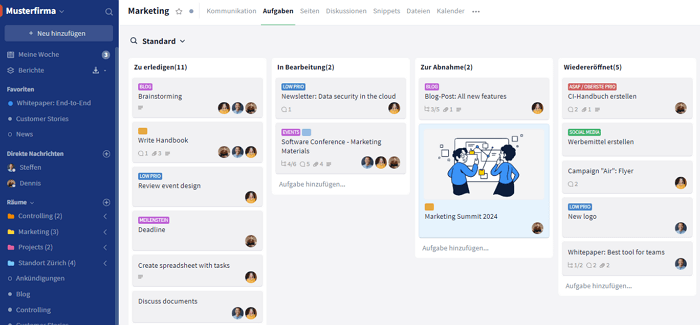
Its security profile is straightforward: German data hosting, EU-based subprocessors, true end-to-end encryption, ISO 27001, and BSI C5, making it particularly suitable for the public sector, education, healthcare, and financial services.
Sprint planning tools for project management: Why Stackfield is the logical next step
If you want to make sprint planning truly more efficient, you need to stop switching between Jira, Slack, and Confluence. Once the sprint backlog, communication, and planning boards all exist within a single secure room, the information loss that no best practice can eliminate simply disappears. This is exactly what Stackfield delivers as a German all-in-one platform with true end-to-end encryption, German data hosting, and a clear GDPR-compliant framework for sprint data.
This means: sprint goal, story point estimates, threaded discussions, and time tracking all remain attached to the same work item. Decisions made during sprint planning meetings are documented where the work actually happens, rather than disappearing into a second tool. Velocity, capacity planning, and the Definition of Done are available in the same project room as discussions about user stories, dependencies, issues identified during the previous retrospective, and even higher-level milestones that connect sprint goals to the overall project plan.
The next step doesn't have to be a migration. It can simply be a trial run. Plan an entire sprint with your team in Stackfield: prioritize the backlog, define the sprint goal, estimate tasks, and manage the sprint using the Kanban board. During the 14-day trial, Stackfield's Customer Success team is available by phone to support you personally – no anonymous ticket system and no pressure to make an immediate decision.
Try sprint planning without risk Many teams already know that their current tool stack isn't ideal, but making a change still feels like a major step. That's exactly what the Stackfield trial is for. Import your backlog, plan a real sprint, and decide afterward. Your dedicated Customer Success contact will guide you through the process by phone. For organizations with formal procurement processes, personal product demonstrations are also available.
Start your free trial
FAQ
Is a general project management tool sufficient for sprint planning?
Yes, provided it combines sprint backlogs, Kanban boards, capacity planning, and integrated communication directly around each work item. Simple task lists without sprint logic, velocity tracking, or burndown charts are rarely sufficient for agile teams and typically result in fragmented planning workflows.
What happens to our sprint data when using a US-based provider?
US providers are subject to the US CLOUD Act regardless of where their servers are located. This means that, under certain circumstances, US authorities may be able to request access to data managed by a US company, even if it is physically stored in Europe. That's why you should always evaluate both the provider's corporate headquarters and its data hosting separately. A data processing agreement under Article 28 GDPR is essential, as it legally defines how the provider may handle your data. EU data residency and transparent EU-based subprocessors are equally important.
How long does it take to move from Jira to an integrated platform?
For a pilot team running both systems in parallel, a realistic timeframe is two to four weeks. Additional teams can then be migrated gradually. Stackfield's Customer Success team supports backlog imports and the first sprint planning sessions by phone, significantly reducing onboarding time.
Can we import existing backlogs into Stackfield?
Yes. Stackfield supports CSV imports, allowing you to migrate structured backlogs from Jira, Trello, and other tools. The Customer Success team provides personal guidance during your first import to ensure a smooth transition.
Do we still need a traditional sprint planning meeting?
Yes. A tool cannot replace the team's shared commitment to the sprint goal. What it does do is make capacity, velocity and dependencies immediately visible during the meeting, significantly reducing its duration by eliminating discussions about the current status.