Every morning starts with prioritizing tasks in Asana, answering Slack threads on the side, joining a Zoom call at noon, updating hours in a separate time-tracking tool in the afternoon, and searching for files somewhere between OneDrive and Asana in between. Despite expensive tool stacks, work still feels fragmented. The reason: true integration is missing, and in the DACH region, GDPR compliance alone is no longer enough when it comes to data protection. Stackfield is one of the few EU providers that solves both problems: a complete all-in-one stack with true end-to-end encryption.
Better flow: Communication and tasks in one place Stackfield delivers the entire workflow in one platform. When chat, tasks, and files merge natively, your team regains its focus. Eliminate subscription chaos and switch to the all-in-one solution from Germany.
Simplify your daily work now
The essentials at a glance
- Reasons for switching: Rising costs, missing native time tracking, and fragmented tool stacks are driving teams away from Asana.
- GDPR vs. E2E: GDPR compliance does not automatically mean nobody can access your data – true end-to-end encryption does.
- Hidden costs: Migration, training, and constant context switching between five different tools consume both budget and focus.
- Stackfield: German all-in-one platform with ISO 27001, BSI C5, and true end-to-end encryption.
Why are teams switching away from Asana in 2026?
The decision to leave Asana is usually not a rejection of task management itself, but of the fragmented tool stack surrounding it. Asana focuses primarily on tasks, while chat, video conferencing, and file management require separate third-party tools such as Slack, Teams, or Dropbox.
This creates three major problems:
- Compliance challenges: For companies in the DACH region, US-based data hosting is a critical issue. Since German server locations in Asana are often reserved for Enterprise customers, many SMEs already fail internal IT security requirements.
- The feature paywall: Essential functions such as time tracking or portfolios are often hidden behind higher-tier plans that are significantly more expensive than the market average.
- Lack of depth: An integration, such as a Slack link inside an Asana task, is not the same as a native workflow, because information still remains scattered across separate databases.
Fragmented work: The real cost of Asana’s tool stack
Asana follows a so-called "best-of-breed" approach: a specialized tool for every function. In theory, this sounds flexible. In practice, it often leads to fragmented workflows and disconnected information..
A standard workflow illustrates the issue: A call happens in Zoom, the resulting decision becomes a task in Asana, the detailed discussion takes place in a Slack channel, and the documentation is stored in Google Drive. This creates several challenges:
- Friction loss: Information has to be manually synchronized between tools. Anyone trying to understand why a task was decided a certain way has to search through chat histories instead of seeing the context directly within the task itself.
- Costs: Beyond the accumulated license fees for four or five tools, the biggest cost factor is the time spent searching for information.
Teams that want to regain focus need to rethink time management and radically reduce the number of isolated tools they rely on.
The solution is a consolidated architecture like Stackfield’s, which removes the separation between communication and tasks. When the chat room also becomes the task workspace and file repository, the administrative overhead of connecting data disappears.
Asana alternatives compared: Features, privacy, pricing
When switching tools, seven criteria matter most: task management, project views (Kanban, Gantt, list), native time tracking, integrated communication, whiteboards, file management, and data protection standards including server location, encryption, certifications, and support quality.
| Criteria: |
Stackfield |
ClickUp |
Monday.com |
OpenProject |
MeisterTask |
| Task management |
✔ |
✔ |
✔ |
✔ |
✔ |
| Kanban / Gantt / List |
✔ |
✔ |
✔ |
⚠ |
⚠ |
| Native time tracking |
✔ |
✔ |
✖ |
✔ |
✔ |
| Chat & video conferencing |
✔ |
⚠ |
✖ |
✖ |
✖ |
| Whiteboard |
✔ |
✔ |
✔ |
✖ |
⚠ |
| File management |
✔ |
⚠ |
⚠ |
⚠ |
⚠ |
| Data hosting in Germany / EU |
✔ |
✖ |
⚠ |
✔ |
✖ |
| True end-to-end encryption |
✔ |
✖ |
✖ |
✖ |
✖ |
| BSI C5 / ISO 27001 |
✔ |
✖ |
⚠ |
⚠ |
⚠ |
| German-language support |
✔ |
✖ |
⚠ |
✔ |
✔ |
✔ = available / fulfilled
⚠ = limited / only partially available / optional
✖ = not available / not fulfilled
Stackfield: All-in-one tool with true end-to-end encryption
Stackfield is the only alternative in this comparison that combines a complete project management and collaboration stack with true end-to-end encryption. This means all content is encrypted directly on the device before it ever reaches the server. Not even Stackfield itself can access messages, files, or tasks. Tasks, Kanban boards, Gantt charts, chat, audio and video conferencing with screen sharing, whiteboards, time tracking, and a collaborative office suite are all integrated natively without relying on third-party providers.
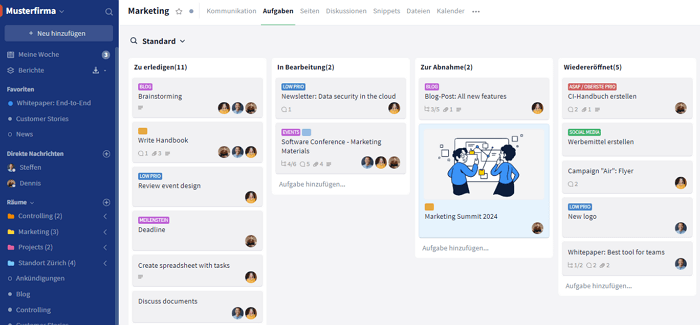
Strengths:
- The only alternative in this comparison with true end-to-end encryption.
- Certified with ISO 27001, BSI C5, ISO 27017, and ISO 27018.
- Exclusively German subprocessors.
- Personal phone and chat support in German, no chatbots.
- All-in-one platform replacing Slack, Zoom, and separate time tracking tools at the same time.
Limitations:
A minimum of five licenses is required, making it unsuitable for individuals or very small teams.
Best suited for:
Teams of any size looking to consolidate project management and collaboration. Particularly suitable for the public sector, education, healthcare, and finance, as well as organizations throughout the DACH region aiming to avoid dependency on US providers.
Pricing:
Starter from €9 per user / month, Business from €14, Enterprise from €28 (all billed annually, minimum of 5 licenses). Includes a 14-day trial without a credit card.
ClickUp: Feature-rich, but US-based
ClickUp is a US-based Asana alternative with a strong focus on project management. For teams in the DACH region with strict data protection requirements, the lack of an EU server location remains a challenge.
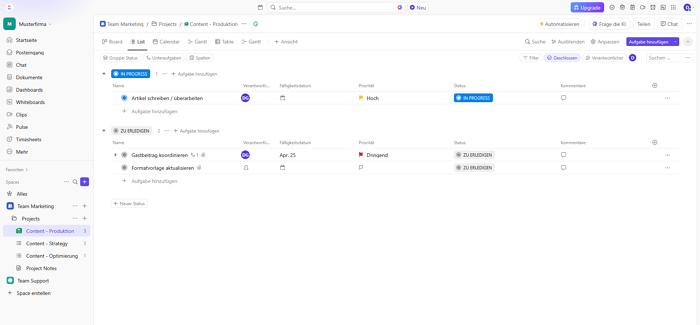
Strengths:
Extensive views and automations, native chat and whiteboard functionality, and a free entry-level plan.
Limitations:
US servers, no true end-to-end encryption, no German-language support, and a steep learning curve.
Best suited for:
Teams without elevated compliance requirements that prioritize maximum functionality and do not require German-language support.
Pricing:
Free basic version available. Unlimited from $7 per user / month, Business from $12 per user / month, Enterprise pricing available on request.
Monday.com: Strong visual workflows, but data hosting outside the EU
Monday.com is an alternative focused on visual boards. EU data hosting is not standard but only available as a special option. Its subprocessors are located outside the EU.
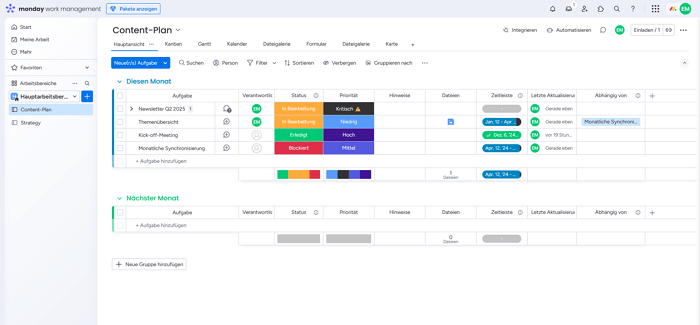
Strengths:
Flexible boards, strong automations, and an easy onboarding experience.
Limitations:
EU data hosting only available as a special option, no true end-to-end encryption, no native time tracking, and no phone support.
Best suited for:
Teams without elevated compliance requirements that primarily need visual project management.
Pricing:
Basic from €9 per user / month, Standard from €12, Pro from €19, Enterprise pricing on request (minimum of 3 users, annual billing).
OpenProject: Open source with a GDPR focus
OpenProject is an open-source collaboration tool with EU-based server hosting. For teams without dedicated IT resources, however, self-hosting can significantly increase administrative overhead.
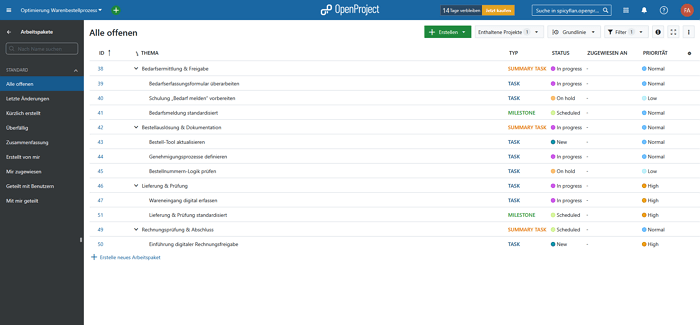
Strengths:
Open source, EU data hosting, ISO 27001 / 27018 certifications, and optional self-hosting.
Limitations:
No chat, no video conferencing, no whiteboard functionality, and self-hosting requires internal IT resources.
Best suited for:
Technically experienced teams or organizations with their own IT infrastructure that prefer full control over their data.
Pricing:
Community Edition free (self-hosted), Basic from €5.95 per user / month, Professional from €10.95, Premium from €15.95 (annual billing).
MeisterTask: German Kanban tool with time tracking
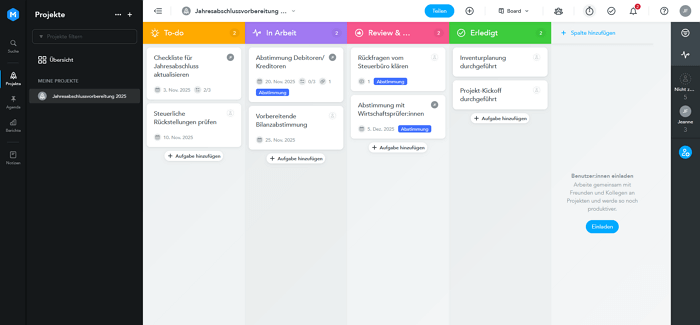
MeisterTask is a German Asana alternative focused on Kanban workflows with native time tracking. Since subprocessors run on Google infrastructure, true data sovereignty is not fully guaranteed.
Strengths:
German provider, native time tracking, easy usability, and German-language support.
Limitations:
No chat, no video conferencing, whiteboard functionality only through external integrations, and Google infrastructure used as a subprocesser.
Best suited for:
Teams looking for a simple Kanban solution from a German provider without elevated compliance requirements.
Pricing:
Free plan available (limited functionality), Pro from €13.50 per user / month, Business from €24, Enterprise pricing on request (annual billing).
How do you choose the right Asana alternative?
The decision depends on which criteria are mandatory for your team and which are optional. The following matrix maps the most important selection factors to specific use cases, ranging from compliance requirements and all-in-one functionality to onboarding effort and support language.
| Criteria: |
Relevant if ... |
| True end-to-end encryption |
... sensitive project data is being processed and even the provider itself must not have access to it. |
| BSI C5 / ISO 27001 |
... authorities, healthcare, finance, or education require mandatory security certifications. |
| All-in-one stack |
... chat, video conferencing, tasks, and files should exist within a single platform. |
| Native time tracking |
... projects need to be billable or internal capacities must be managed. |
| Learning curve / onboarding |
... the team should become productive quickly without extensive workflow setup. |
| Multilanguage support |
... personal accessibility and support in the local language are expected. |
| Open source / self-hosting |
... internal IT resources are available and full operational control is preferred. |
No single Asana alternative covers all of these areas simultaneously. The right choice depends on whether you simply want to manage tasks or establish a new operational foundation for your entire team.
Switching from Asana in public sector and regulated industries
For public authorities, universities, healthcare organizations, and financial service providers, BSI C5, NIS2, DORA, and GDPR-compliant data processing agreements are not optional requirements – they are mandatory standards. This is exactly where many US-based tools effectively fall short: US data hosting, missing end-to-end encryption, and subprocessors outside the EU cannot be fully compensated for through additional contracts alone. Stackfield, as a BSI C5-certified and ISO 27001-certified solution, is specifically designed to meet these requirements natively without requiring separate compliance packages or Enterprise upgrades.
Requirements at a glance:
- Public sector: BSI C5, German data hosting, GDPR-compliant data processing agreements under Art. 28 GDPR, no US-based subprocessors.
- Healthcare: Confidentiality of patient data, ISO 27001, true end-to-end encryption, documented access control.
- Finance / Insurance: DORA readiness, proof of resilience and IT security, EU-only data processing.
- Education / Research: GDPR-compliant storage of research data, NIS2 requirements, no external tracking.
Stackfield: The German Asana alternative with true end-to-end encryption
Teams leaving Asana because of compliance gaps, tool chaos, or rising costs are usually looking for a more integrated alternative. Stackfield is the only solution that natively combines task management, chat, and file management in one platform, protected by true end-to-end encryption on German servers.
The transition happens without disruption: the Customer Success team supports you throughout the migration process, from defining the right workspace structure to setting up permissions. With an OMR rating of 4.8 stars and references from the public sector and healthcare industry, Stackfield is the logical choice for teams that want to combine security and daily collaboration in a single tool.
Experience project management, chat, and time tracking in one platform Are you currently using Asana together with Slack, Zoom, and a separate time-tracking tool? Test for 14 days what consolidated work in a single platform feels like. Includes a personal contact person and no automatic renewal.
Start your free trial
FAQ
What is the difference between GDPR compliance and end-to-end encryption?
GDPR compliance means the provider fulfills legal obligations such as data processing agreements, purpose limitation, and access rights, but technically still has access to your data. True end-to-end encryption excludes even the provider itself, because only authorized users possess the encryption keys. Stackfield combines both: legal compliance and technical inaccessibility for the provider.
Which requirements apply to public authorities and regulated industries?
Public authorities, universities, and regulated industries require solutions with BSI C5, ISO 27001, and NIS2 readiness. Stackfield fulfills these requirements natively: BSI C5 certified, ISO 27001 certified, German data hosting, GDPR-compliant processing agreements under Art. 28 GDPR, and true end-to-end encryption, without requiring additional contracts or Enterprise upgrades.
Can I easily migrate my Asana data to another platform?
Popular alternatives such as Stackfield and ClickUp offer Asana importers for tasks, projects, and responsibilities. A phased migration approach has proven effective: set up a pilot project, run it in parallel with Asana, and then fully migrate. Stackfield’s personal Customer Success team supports this process by phone, from workspace structure to permission management.
Which Asana alternatives offer native time tracking without third-party tools?
Stackfield, MeisterTask, and awork provide native time tracking without requiring third-party apps. For teams leaving Asana because of missing time tracking functionality, this removes the need for separate tools, additional license costs, separate reporting, and duplicate maintenance. Time entries are created directly within tasks and automatically flow into reports.