About the City of Brunsbüttel
The maritime port and industrial city Brunsbüttel is located in the triangle of North Sea, Elbe and Kiel Canal in Northern Germany. Since December 2024, the local government of the small town has been using Stackfield for its collaboration and now manages a wide range of processes and projects digitally in one central location. Joscha Thoenes has been part of the Department of Internal Administration and Organization at the City of Brunsbüttel for almost ten years and witnessed and helped shape Stackfield’s early days at the agency.
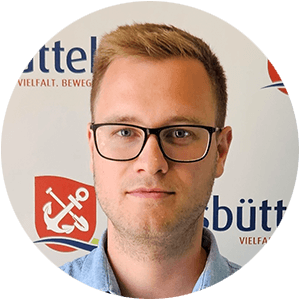
Joscha Thoenes – Internal Administration and Organization
Moving away from Excel spreadsheets and toward collaborative task management
It was only with Stackfield that the City of Brunsbüttel first gained experience with targeted project and task management. Previously, work had been organized primarily using Excel spreadsheets, emails, phone calls, and meetings, in addition to a DMS system. In particular, tasks were mainly completed and structured in Excel. There wasn’t really a proper structure in place,
said Joscha Thoenes. The limited collaboration capabilities, in particular, made the work cumbersome and tedious, as changes to files could only be made by one person at a time.
Thus, to create more structure, flexibility, and opportunities for transparent collaboration in the City of Brunsbüttel, a solution was sought that would provide sufficient channels for communication and collaboration. In particular, the goal was to be able to work on tasks simultaneously and ensure access from anywhere, including while on the go. Task management needed to be easy to understand while also being comprehensive enough.
Stackfield was discovered by Joscha Thoenes and his team through a colleague. The fact that Stackfield was a German company with data stored on German servers was particularly convincing. Data protection was, of course, very important to us. Our data protection officer is quick to point out the issue and remind us to pay attention to it,
says Joscha Thoenes. Stackfield offered the best combination of various factors: in addition to high standards for data protection, it provided sufficient flexibility in task management and, above all, a user-friendly interface.
The various tools are similar, but we got along best with Stackfield. We went through an extended testing phase, and after a relatively short time, we couldn’t imagine using anything else.
Task management down to the smallest detail
Today, Stackfield is used in numerous departments within the City of Brunsbüttel, including the Human Resources and Organization
department, IT, the fire department, city management, the port authority, and by various executives – a rollout to all departments is planned for the near future. The room, Stackfield’s specially defined workspace, is configured differently depending on the specific use case. We usually stick to the basics,
says Joscha Thoenes.
The standout feature are the tasks, which allow users to organize and track their to-do lists. Tasks can be assigned to specific people and given deadlines; comments can be posted directly on the task card; and files can be attached to the task, remaining firmly linked. Using subtask lists, tasks can also be broken down into separate steps, each of which can be individually dated and assigned. Tasks assigned to oneself are listed in the personal dashboard My Week
under the corresponding day. This ensures clarity about current and pending tasks at all times.
An overview of a room’s tasks is provided by the Kanban board. Depending on a task’s status, it is moved back and forth between the board’s various columns. This makes it clear at a glance whether a task needs to be completed, is in progress, or has been completed. Clicking on a task allows you to view and edit its details. Everything that runs through the Kanban board is a real game-changer,
emphasizes Joscha Thoenes. If tasks have deadlines, especially those spanning several days, Joscha Thoenes and his colleagues often use the timeline module to display them as a Gantt chart. This makes the timeline and dependencies between tasks visible at a glance. To create tasks even more easily and quickly, Joscha Thoenes and his team are creating new task templates step by step. This makes processes even more efficient.
Rooms in Stackfield ensure transparency, especially in cases of sick leave
The fact that numerous projects and processes at the City of Brunsbüttel are now managed in Stackfield is a clear benefit for Joscha Thoenes and his colleagues, especially when it comes to transparency. You always know what your colleagues are working on. Anything that’s a bit more complex or important finds its way into Stackfield. This allows us to organize ourselves much more effectively,
explains Joscha Thoenes. Access to the contents of a room is available to everyone included in that room. Changes to tasks and other elements such as polls, files, or pages (Stackfield’s text documents) are displayed in a history view visible to everyone, and people can be tagged and addressed at any time.
Having information bundled and accessible in the room is particularly helpful when someone is absent, Joscha Thoenes emphasizes. If a person is unable to work due to illness, a substitute can open the task and use the card to access the latest updates, important materials, and so on. If necessary, urgent work can thus be redistributed without any problems, and deadlines can still be met. When the absent person returns, changes to the room’s content remain visible even after the fact, and missed work can be quickly caught up on and understood. That’s definitely an advantage,
says Joscha Thoenes. He emphasizes that colleagues are encouraged to collaborate in team rooms precisely for this reason. This way, work remains accessible not only in cases of illness or planned absences but managers also have the opportunity to keep track of current statuses and can follow up on specific points as needed.
Cross-departmental collaboration within the City of Brunsbüttel
The various departments of City of Brunsbüttel share a common organizational structure in Stackfield, enabling them to communicate and collaborate across departments via rooms, group chats, or private chats. Our department in the organizational division, in particular, works closely with our IT department; there’s a significant amount of task sharing there,
explains Joscha Thoenes.
The city’s IT department handles numerous projects from start to finish
in Stackfield, such as the implementation of the digital inbox at the city. Joscha Thoenes’ department, Internal Administration and Organization,
regularly takes on the organizational aspects when it comes to the technical implementation of various enhancements or bug fixes. We communicate with each other quite a lot and collaborate with various colleagues,
emphasizes Joscha Thoenes. Examples of this include troubleshooting issues, further developing the DMS program, and introducing new AI systems. In these dedicated rooms, managers from the involved departments are included, giving them access to issues, activities, and the current status of the other department, and allowing them to ask questions or provide feedback as needed – a benefit of Stackfield that visibly increases efficiency in cross-departmental processes and makes tedious back-and-forth emailing obsolete.
Mobile use of Stackfield in meetings
One of the shortcomings identified in collaboration before Stackfield was introduced, and a key requirement in the search for a collaboration solution, was the lack of options for accessing content on the go and making changes from mobile devices. Stackfield offers exactly these capabilities, allowing users to view and edit content in the conference room or between offices: in addition to the desktop app and web application in the browser, Stackfield can also run as a mobile app on the iPad or smartphone. Especially during meetings, Stackfield is now actively used by the City of Brunsbüttel. You just bring your iPad along and have all your tasks together in every meeting. We didn’t have that before, and it makes us significantly more agile and faster today,
praises Joscha Thoenes. During the meeting, tasks can be rescheduled or assigned, messages sent, or content accessed without having to wait until returning to the desk.
Multi-project management across organizational boundaries
In the future, the focus is on bringing in project work and project portfolios, as well as collaboration with external users, according to Joscha Thoenes. The City of Brunsbüttel is eager to add new use cases, further expand existing structures, and, of course, roll out the system to other areas as soon as the necessary approvals are in place. Stackfield is set to remain an integral part of daily operations.